Home food preservation is the skill that converts a productive garden, a bulk purchase of raw ingredients, or a seasonal surplus into months of shelf-stable food. It’s also where more food preparedness mistakes happen than anywhere else — because improper canning specifically can produce food that looks fine and will kill you.
This guide covers the three main preservation methods used by preppers: canning, dehydrating, and vacuum sealing. For each, it covers what the method actually does, what it’s good for, and how to do it correctly.
Method 1: Pressure Canning
What Canning Actually Does
Canning creates a sealed, sterile, shelf-stable product by heating food to temperatures that kill microorganisms, then sealing the jar to prevent recontamination. Done correctly, home-canned food is safe for 1–5 years. Done incorrectly, it can harbor Clostridium botulinum — botulism — a toxin so lethal that a fraction of a teaspoon can kill an adult.
This is not said to scare you away from canning. It’s said to ensure you understand that canning has one non-negotiable requirement: follow tested recipes exactly.
Water Bath vs. Pressure Canning
Water bath canning uses boiling water (212°F) to process food. It is safe only for high-acid foods (pH 4.6 or lower): fruits, pickles, jams, jellies, and tomatoes with added acid. The high acid environment prevents botulism growth.
Pressure canning uses steam pressure to reach 240°F — temperatures that kill botulism spores. It is required for all low-acid foods: vegetables, meat, poultry, fish, beans, and soups.
Equipment
For water bath canning:
- Large pot with rack and lid (your largest stock pot works)
- Jar lifter
- Canning jars (Ball or Kerr Mason jars)
- New lids each use (bands are reusable; lids are not)
- Canning funnel
For pressure canning:
- Pressure canner (not a pressure cooker — a dedicated pressure canner with a gauge)
- All of the above

All American 921 21.5-Quart Pressure Canner
Metal-to-metal seal, no rubber gasket to replace. Three safety valves. Processes 19 pint jars or 7 quart jars per batch. The most reliable pressure canner for long-term use.
⚠ Affiliate link — we earn a small commission at no extra cost to you.
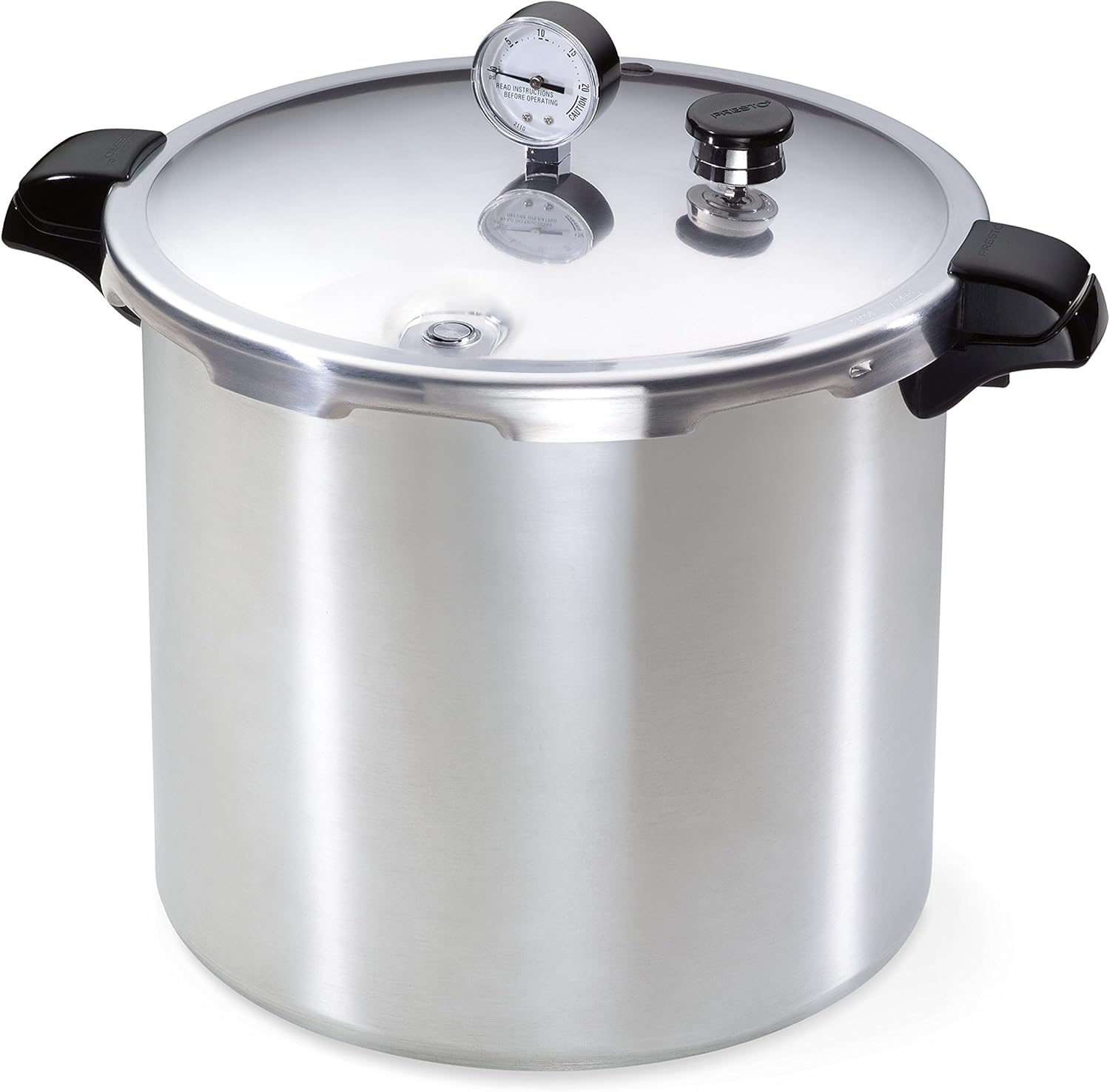
Presto 23-Quart Pressure Canner
Dial gauge, aluminum construction. Processes 20 pint jars or 7 quart jars. More affordable entry point. Annual gauge testing recommended. A reliable starter pressure canner.
⚠ Affiliate link — we earn a small commission at no extra cost to you.
Ball Mason Jar Regular Mouth (12-pack, quart)
Standard quart Mason jars. Wide-mouth and regular-mouth both work; wide-mouth is easier to fill. Buy lids separately. Reusable indefinitely with annual lid replacement.
⚠ Affiliate link — we earn a small commission at no extra cost to you.
What’s Worth Canning
High value to pressure-can at home:
- Dried beans (pre-cooked in jars — much faster to use than dry beans in a crisis)
- Chicken and beef (buy in bulk when on sale)
- Vegetable soup and stew (complete meals in a jar)
- Potatoes, carrots, corn from a garden surplus
High value to water-bath can:
- Tomatoes and salsa (garden surplus)
- Jams and preserves from fresh fruit
- Pickles (cucumbers, jalapeños)
- Apple butter and applesauce
Method 2: Dehydrating
What Dehydrating Does
Dehydration removes 80–95% of moisture from food using low heat and air circulation, creating a shelf-stable product that resists microbial growth. It’s simpler than canning, more forgiving of error, and the results are more compact and lightweight than canned food.
Shelf life: 1–2 years at room temperature in sealed containers; 3–5 years frozen; up to 25 years in vacuum-sealed containers with oxygen absorbers.
Equipment
A food dehydrator provides controlled, consistent heat and airflow — far better than oven drying, which is inconsistent and expensive to run.
Excalibur 3926TB 9-Tray Electric Food Dehydrator
9 trays, 15 square feet of drying space. Rear-mounted fan for even heat distribution. Adjustable thermostat 105–165°F. The standard recommendation for serious food preservation. Handles full garden harvests.
⚠ Affiliate link — we earn a small commission at no extra cost to you.

Nesco FD-75A Snackmaster Pro Food Dehydrator
5-tray expandable (up to 12 trays). Top-mounted fan. 600W. A capable mid-range dehydrator for households without high-volume preservation needs. Good starting point.
⚠ Affiliate link — we earn a small commission at no extra cost to you.
What’s Worth Dehydrating
Excellent candidates:
- Fruits: Apple slices, banana chips, mango, strawberries, blueberries — natural sugars accelerate drying and the results are excellent
- Vegetables: Corn, peas, green beans, tomatoes (sun-dried), onions, mushrooms, carrots — add directly to soups and stews without reconstitution
- Jerky: Beef, venison, turkey — high protein, excellent shelf life, valuable emergency food
- Herbs: Dry garden herbs in season for year-round use
- Cooked beans: Cook dried beans, dehydrate — faster to rehydrate than raw beans, no pressure canning required
Method 3: Vacuum Sealing
What Vacuum Sealing Does
Vacuum sealing removes air from a bag or container before sealing, dramatically slowing oxidation and preventing freezer burn. For dry goods, it significantly extends shelf life. For refrigerated and frozen items, it extends usable storage by 3–5×.
Important distinction: Vacuum sealing alone does not make food shelf-stable. It slows degradation; it does not sterilize. Vacuum-sealed dry goods stored at room temperature still benefit from cool, dark conditions. Vacuum-sealed moist foods still require refrigeration or freezing.
For maximum shelf life of dry goods: Vacuum seal into bags or Mason jars, add an oxygen absorber, store in a food-grade container in a cool, dark location.

FoodSaver FM5200 2-in-1 Automatic Vacuum Sealer
Seals bags and Mason jar lids (with attachment). Automatic moisture detection. Includes roll of bag material. The standard recommendation for household food preservation.
⚠ Affiliate link — we earn a small commission at no extra cost to you.
FoodSaver Vacuum Seal Bags (Quart, 44-count)
BPA-free multi-layer bags. Compatible with FoodSaver and most other vacuum sealers. Microwave and freezer safe. Buy in bulk — you'll use more than you expect.
⚠ Affiliate link — we earn a small commission at no extra cost to you.
Best Uses for Vacuum Sealing
High value applications:
- Bulk dry goods: Portion rice, oats, pasta, and beans into meal-sized quantities, vacuum seal, add oxygen absorber. This extends shelf life to 20–30 years and creates pre-portioned emergency rations.
- Freeze extension: Meat, fish, and poultry last 1–3 years frozen (vacuum sealed) vs. 4–6 months (conventionally wrapped).
- Coffee and spices: Coffee stays fresh 2–3× longer vacuum sealed. Spices retain potency for years.
- Important documents: Vacuum sealing documents, matches, fire starters, and other sensitive items in a bug-out bag protects them from moisture.
Combining Methods: The Preservation Stack
The most effective home preservation program uses all three methods for different purposes:
| Food | Best Method | Why |
|---|---|---|
| Meat and protein in bulk | Pressure canning | Shelf-stable, no refrigeration |
| Tomatoes and garden produce | Water bath canning | Safe for high-acid content |
| Fruit, jerky, vegetables | Dehydrating | Lightweight, long shelf life |
| Bulk grains and beans | Vacuum seal + O2 absorber | Cheapest, 25+ year shelf life |
| Cheese, butter | Pressure canning (clarified butter) | Extends highly perishable items |
| Complete meals (soup, stew) | Pressure canning | Best convenience under stress |
Safety Summary
Non-Negotiable Rules
- Use only tested recipes from the USDA, Ball, or university extension services. Do not adapt recipes for canning.
- Pressure can all low-acid foods — all vegetables, all meat, all beans, all soups containing vegetables or meat.
- Test your pressure canner gauge annually — county extension offices often do this free.
- Never skip the processing time in a recipe — it’s not a suggestion.
- Inspect all seals before consuming — if a lid flexes, smells off, or shows any sign of damage, discard the contents.
Resources for Safe Recipes
- USDA Complete Guide to Home Canning (free PDF from USDA website)
- Ball Blue Book of Preserving (the definitive printed reference)
- National Center for Home Food Preservation (nchfp.uga.edu) — free, science-based, authoritative
Ball Blue Book Guide to Preserving (37th Edition)
The definitive reference for home canning, dehydrating, and preserving. Over 500 tested recipes. Updated safety guidelines. Every home preserver should have a physical copy.
⚠ Affiliate link — we earn a small commission at no extra cost to you.
Getting Started
If you have no preservation experience, start here:
Week 1: Buy a water bath canning kit and make one batch of jam or salsa. This teaches the fundamentals with forgiving, high-acid food.
Month 1: Invest in a pressure canner. Can one batch of beans. The beans you pressure-can yourself are significantly cheaper than store-bought canned beans and last just as long.
Month 2–3: Buy a mid-range food dehydrator. Dehydrate a batch of sliced apples and a batch of beef jerky. These are simple, high-success-rate starting projects.
Month 3+: Invest in a vacuum sealer. Begin vacuum-sealing bulk dry good purchases in meal-sized portions.
The skills compound. A household that can pressure-can, dehydrate, and vacuum seal is capable of converting raw, cheap ingredients into a multi-year emergency food supply — at a fraction of the cost of buying pre-packaged survival food.
That’s the point of learning this. Not the process — the outcome.