Solar power for preparedness is not the same problem as whole-home solar electrification. You don’t need to power your HVAC, your electric dryer, or your 75-inch TV. You need to power a refrigerator, some lighting, a phone charger, and possibly a medical device. The gap between those two problems is massive — in cost, complexity, and installation requirements.
This guide covers the portable and semi-portable solar approach: buying and pairing components to power critical loads indefinitely using sunlight, without a licensed electrician or a five-figure investment.
How Solar Power Works (The Short Version)
A solar power system has three components:
- Solar panels — convert sunlight to DC electricity
- Battery storage — store electricity for use when the sun isn’t shining
- Inverter — converts DC battery power to AC (standard household current) for most devices
In a modern portable power station (Jackery, EcoFlow, Bluetti), all three components are integrated into one unit. You pair the station with portable panels, and the system runs without tools, electrical knowledge, or permanent installation.
The alternative — a full DIY system with separate components — offers more capacity and lower cost per watt-hour but requires more knowledge to design and install safely.
Step 1: Calculate Your Critical Load
Before buying anything, identify what you need to power and for how long.
Common critical loads and their power draw:
| Device | Typical Watt Draw | Hours/Day | Daily Watt-Hours |
|---|---|---|---|
| Chest freezer (full, efficient) | 30–60W average | 24 | 400–700 Wh |
| Full-size refrigerator | 100–150W average | 24 | 800–1,500 Wh |
| LED lighting (4 bulbs) | 40W | 6 | 240 Wh |
| Phone charging (family of 4) | 25W | 3 | 75 Wh |
| CPAP (without heat) | 30–50W | 8 | 240–400 Wh |
| Laptop | 45–65W | 4 | 180–260 Wh |
| Small fan | 35W | 8 | 280 Wh |
Finding your device’s actual draw: Check the label on the device or its power adapter. It will list watts (W) or you can calculate: volts × amps = watts.
The Portable Power Station Approach
For most households, a portable power station paired with solar panels is the practical starting point. No installation, no electrical knowledge required, and the unit doubles as a battery backup for everyday minor outages.
Choosing a Power Station
Key specs:
- Capacity (Wh): Total stored energy. A 1,000Wh station stores 1 kWh.
- Output (W): Maximum power it can supply at once. Devices with motors (refrigerators, pumps) have surge requirements that need to be below the station’s peak output rating.
- Input (W): Maximum solar charging rate. Higher input means faster solar recharging.
- Cycle life: How many charge/discharge cycles before capacity degrades significantly. LiFePO4 chemistry (lithium iron phosphate) offers 2,000–3,500 cycles; standard lithium-ion offers 500–1,000.
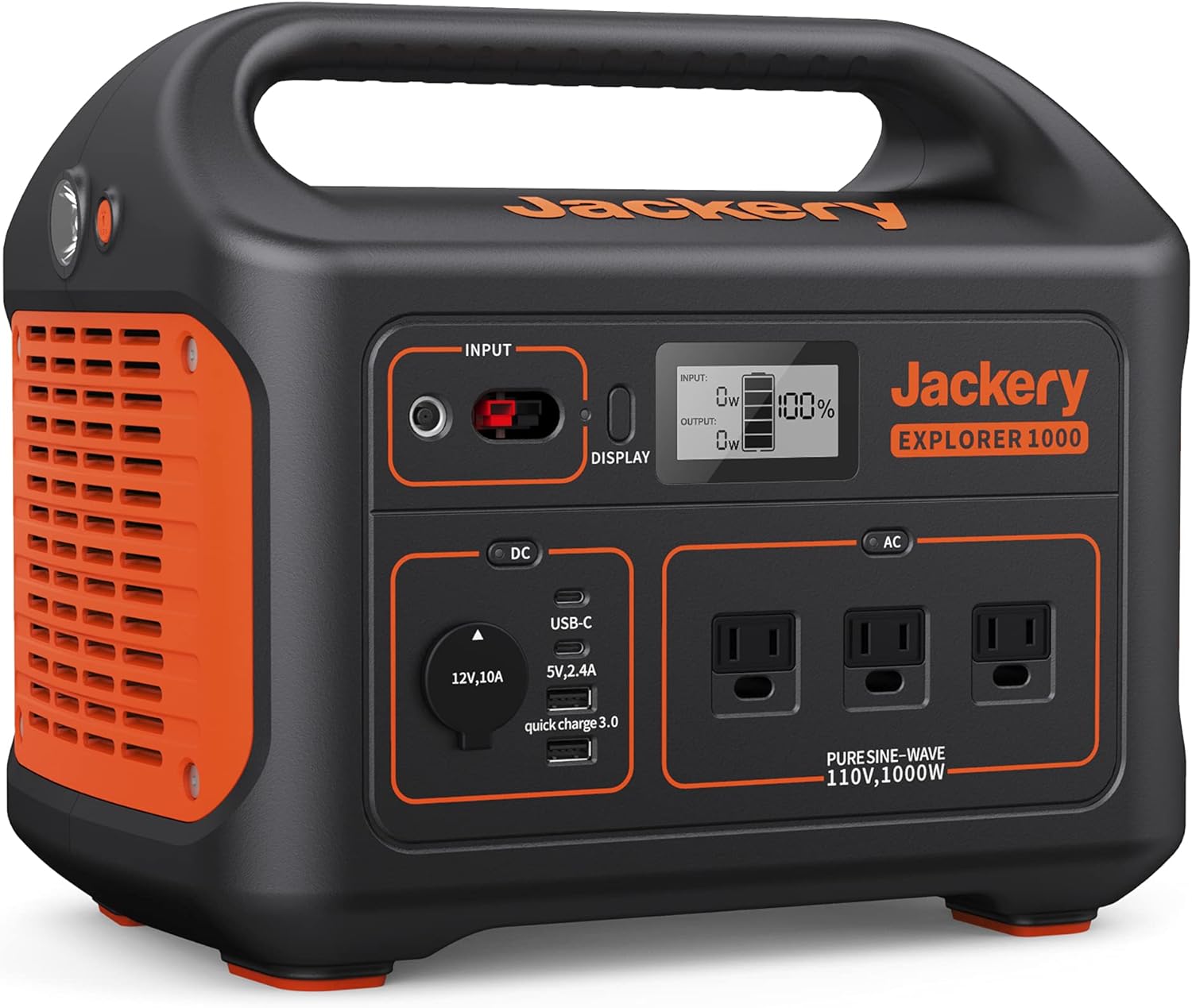
Jackery Explorer 1000 Pro Portable Power Station
1002Wh LiFePO4 battery, 1000W output (2000W surge), 800W max solar input. Powers a full-size refrigerator for 8–10 hours or charges phones all week. The benchmark mid-range portable power station.
⚠ Affiliate link — we earn a small commission at no extra cost to you.
EcoFlow Delta 2 Portable Power Station (1024Wh)
LFP battery, 1800W output, fastest charging in class (0–80% in 50 minutes from AC). 1024Wh. 3,000 cycle life. Excellent inverter efficiency. Competitive with Jackery at similar price point.
⚠ Affiliate link — we earn a small commission at no extra cost to you.
Bluetti AC200P Portable Power Station (2000Wh)
2000Wh, 2000W output, seven charging methods including dual AC + solar simultaneously. For powering a refrigerator continuously or running a household for multiple days. The serious-capacity option.
⚠ Affiliate link — we earn a small commission at no extra cost to you.
Choosing Solar Panels
Panels are rated in watts of output under standard test conditions (full sun, 77°F). Real-world output is typically 70–85% of rated wattage due to heat, angle, and atmospheric variation.
Key specs:
- Wattage: Higher is more output and faster charging
- Portability: Folding panels (briefcase-style) are highly portable; rigid panels produce more per dollar but require mounting
- Compatibility: Most portable panels use MC4 or proprietary connectors; verify compatibility with your power station
Sizing your panels: To recharge a 1,000Wh station in a day, you need sufficient panel output to replace what you used. In a 5-hour peak sun day (average for most of the US), a 200W array produces ~1,000Wh. Panels never run at rated output; budget for ~80% efficiency.
Jackery SolarSaga 200W Solar Panel
Foldable 200W panel. Compatible with Jackery power stations and any MC4-equipped station. IP67 waterproof. Kickstand for angle adjustment. Charges a Jackery 1000 from 0–80% in ~5 hours of direct sun.
⚠ Affiliate link — we earn a small commission at no extra cost to you.
Renogy 100W Rigid Monocrystalline Solar Panel
100W rigid panel for semi-permanent installation. MC4 connectors. More output per dollar than folding panels. Requires a mount or improvised angled support. Best for stationary preparedness installations.
⚠ Affiliate link — we earn a small commission at no extra cost to you.
The Recommended Solar Setups by Budget
Under $500 — The Critical Essentials Setup
A smaller power station and modest panel array handles lighting, phone charging, radio operation, and laptop use.
- EcoFlow River 2 (256Wh) — ~$200
- 100W folding solar panel — ~$150
- Total: ~$350
- Powers: Lighting, phones, radio, laptop, small fans. Not a refrigerator.
$700–$1,000 — The Refrigerator Setup
A 1,000Wh station with 200W of panels can maintain a chest freezer indefinitely in good sun conditions.
- Jackery Explorer 1000 Pro or EcoFlow Delta 2 — ~$650–700
- 200W folding panel — ~$250–300
- Total: ~$950
- Powers: Chest freezer, lighting, phones, medical devices. Possibly a small refrigerator with conservation.
$1,500–$2,500 — The Household Essentials Setup
A 2,000Wh station with 400W+ of panels handles a refrigerator, lighting, devices, and fans continuously.
- Bluetti AC200P (2,000Wh) — ~$1,200
- Two 200W panels — ~$500
- Total: ~$1,700
- Powers: Full-size refrigerator, all lighting, all devices, fans, CPAP. Not HVAC or high-draw appliances.
Real-World Solar Limitations
Cloudy Days
Solar panels produce 10–25% of rated output on overcast days. A system sized for clear days may struggle in a week of cloud cover.
Mitigation: Size your battery bank for 2–3 days of storage, allowing you to ride out short cloudy periods without the panels.
Winter and Latitude
At higher latitudes in winter, both available daylight hours and panel efficiency decrease. A system that easily covers summer loads may be undersized for December.
Mitigation: Understand your local peak sun hours (NREL’s PVWatts tool provides this free) and size panels accordingly.
Security
Portable solar panels left outside are theft targets in civil unrest scenarios. Plan for secure storage or bring equipment in at night.
Permanent Installation vs. Portable
A permanent rooftop solar system with grid-tie or battery backup (Tesla Powerwall, Enphase Encharge, etc.) provides whole-home power but costs $15,000–$40,000+ installed and requires professional installation.
For most preppers, portable systems provide 80% of the preparedness value at 5–10% of the cost. If you already have or are planning a whole-home solar system, ensure it includes a battery backup that functions during grid outages — most grid-tie systems without a battery shut off when the grid goes down (a safety requirement for utility workers).