A portable power station is a large battery with built-in inverter, charge controller, and multiple output ports. Charge it from a wall outlet or solar panels; discharge it into any device. No generator, no gasoline, no fumes, no noise.
For short to medium outages — a few hours to a few days — a power station is cleaner, quieter, and simpler than a generator. Paired with solar panels, it becomes an indefinitely rechargeable off-grid power source.
This guide cuts through the brand noise with a clear framework for matching power station size to actual preparedness needs.
Understanding the Key Specs
Capacity (Watt-Hours, Wh)
Watt-hours tell you how much energy is stored. A 1,000Wh station stores 1 kilowatt-hour — the same amount of energy that a 100-watt device uses in 10 hours, or a 1,000-watt device uses in 1 hour.
Quick math: (Watt-hours ÷ Device wattage) × efficiency factor (0.85) = Hours of runtime
A 500Wh station running a 50W CPAP machine: (500 ÷ 50) × 0.85 = 8.5 hours. Enough for one night.
Output (Watts)
The maximum power the station can deliver at once. If your device draws more than the station’s rated output, the station either cuts out or shows an error.
Watch for: Devices with motor starting surge (refrigerators, pumps). A refrigerator rated at 150W running may need 600W to start. Your station’s output must exceed this surge.
Battery Chemistry
Lithium-ion (NMC): Higher energy density (more capacity per pound), lower cost per watt-hour, but fewer charge cycles (500–1,000) before degradation. Most power stations use this.
LiFePO4 (Lithium Iron Phosphate): Lower energy density (heavier per watt-hour), higher cost, but dramatically more charge cycles (2,000–3,500) and inherently safer chemistry (no thermal runaway risk). Better for long-term preparedness use.
For a device you’ll use daily, LiFePO4 is worth the premium. For a device that sits in a closet until needed, the cycle count difference matters less.
Recharge Inputs
- AC (wall outlet): Fastest. Usually 200–1,000W input.
- Solar: Variable — check the max solar input wattage when sizing panels
- 12V car/truck: Slow; useful while driving
- USB-C Power Delivery: For smaller units only
The Size Tiers
Tier 1: Small (100–300Wh) — Phone and Lights
For basic device charging and emergency lighting. Handles phones, tablets, laptops, and LED lighting for 1–3 days. Cannot run a refrigerator.
Best for: Power outages of 1–2 days, supplemental device charging, camping, and vehicle-based preparedness.
EcoFlow River 2 (256Wh)
256Wh, 300W output (600W surge), LFP battery for 3,000 cycle life. 0–100% in under an hour from AC. 256Wh charges a smartphone 20+ times or runs LED lights for days. The best small power station for the money.
⚠ Affiliate link — we earn a small commission at no extra cost to you.
Tier 2: Mid-Range (500–1,100Wh) — Critical Devices + Refrigerator
The most popular category. Large enough to run a chest freezer for 8–15 hours or a full-size refrigerator for 5–8 hours. Can be recharged by solar during the day to extend runtime indefinitely.
Best for: 3–7 day outages with solar recharge, powering a refrigerator overnight, running medical devices continuously.
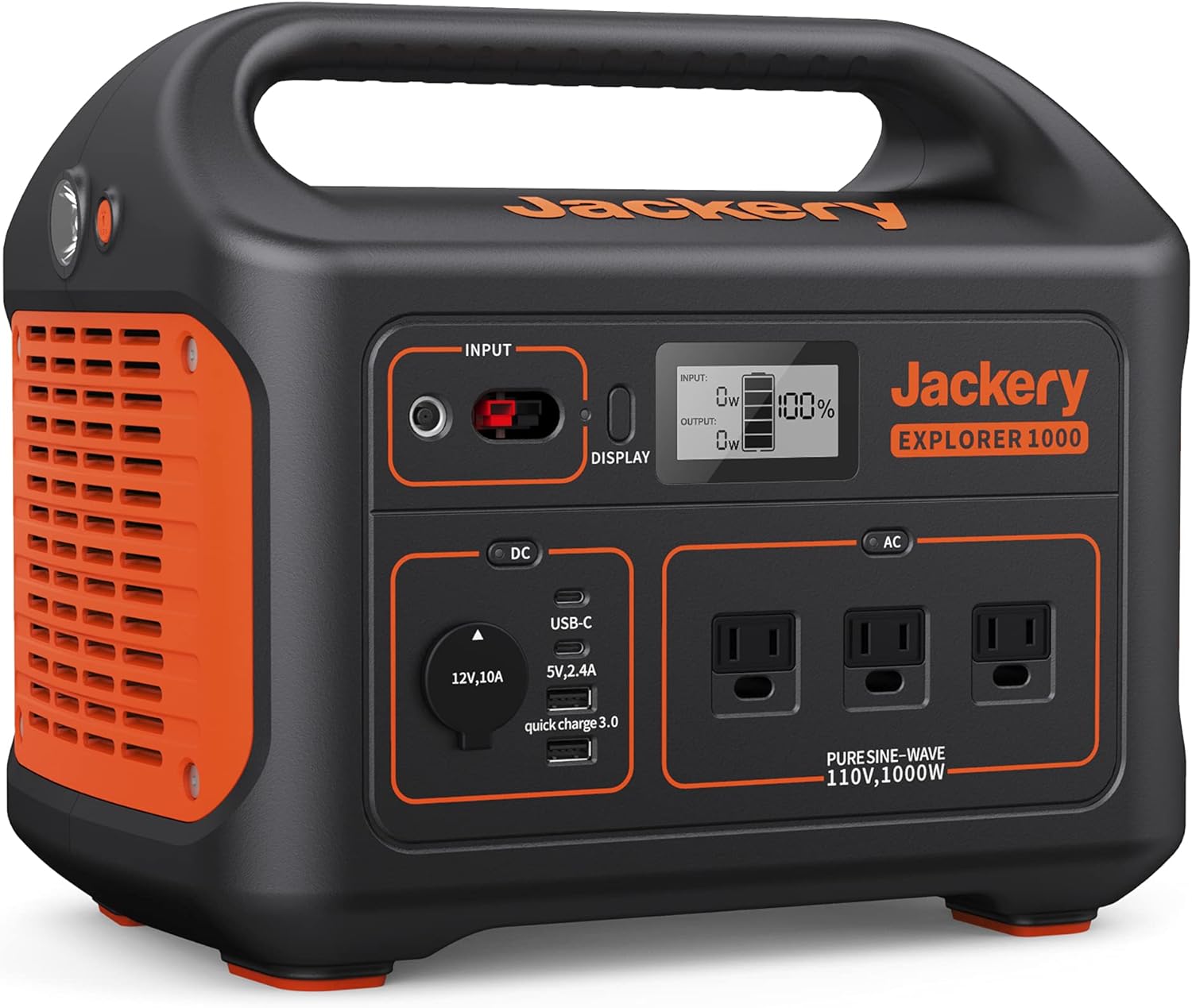
Jackery Explorer 1000 Pro (1002Wh)
1002Wh LFP battery, 1000W output (2000W surge), 800W max solar input. Powers a full-size refrigerator for ~8 hours or a chest freezer for ~15 hours per charge. The benchmark mid-range power station for preparedness.
⚠ Affiliate link — we earn a small commission at no extra cost to you.
EcoFlow Delta 2 (1024Wh)
LFP battery, 1800W output, fastest AC charging in class (0–80% in 50 min). 1024Wh. Higher output than the Jackery 1000 Pro — better for devices with high starting surge. Strong competitor at similar price.
⚠ Affiliate link — we earn a small commission at no extra cost to you.
Tier 3: Large (1,500–3,000Wh) — Household Essentials
Powers a refrigerator continuously (when paired with solar), runs a window AC unit for several hours, handles multiple simultaneous loads. Solar-paired systems at this tier approach genuine off-grid household power for critical loads.
Bluetti AC200P (2000Wh)
2000Wh, 2000W output, seven charging methods. Powers a full-size refrigerator continuously when paired with adequate solar. Multiple AC outlets, USB ports, and 12V outputs. The serious household backup option.
⚠ Affiliate link — we earn a small commission at no extra cost to you.
The Brands
Jackery: The most recognized name. Strong quality control, wide dealer network, excellent solar ecosystem compatibility. Generally uses NMC chemistry in older models, LFP in newer Pro/Plus models. Premium-priced.
EcoFlow: Aggressive on specs — highest output ratings in class, fastest charging. LFP in their River 2 and Delta 2 lines. Good value-to-specs ratio. Chinese company with US operations.
Bluetti: Strong in the large-capacity segment. LFP chemistry across most of their line. Competitive pricing on large units. Similar profile to EcoFlow.
Goal Zero: The original premium outdoor brand, now competing on features rather than price. Yeti line is well-regarded for durability. More expensive per watt-hour than the Chinese brands.
Anker: Strong in consumer electronics generally; their Solix line is newer but well-engineered. Worth considering for comparison.
Battery Banks (Small-Scale)
Distinct from power stations, battery banks are small portable USB chargers — the brick in your bag that recharges your phone. For basic short-term preparedness, a high-capacity battery bank is the minimum power backup.
For preparedness: A 20,000–30,000mAh bank charges a smartphone 5–7 times. For a family of four through a 3-day outage, a single large bank keeps communication devices functional.
Anker 737 PowerBank 24,000mAh (140W)
24,000mAh, 140W total output, charges two devices simultaneously via USB-C and USB-A. Recharges quickly via 65W USB-C input. The high-capacity fast-charging option for phone and laptop backup.
⚠ Affiliate link — we earn a small commission at no extra cost to you.
Miady 10,000mAh Slim Battery Bank (2-pack)
Slim 10,000mAh banks. Dual USB-A output. One per family member covers short outages. The budget option when you need multiple units rather than one high-capacity bank.
⚠ Affiliate link — we earn a small commission at no extra cost to you.
The Solar Pairing
A power station without solar is a large battery — it runs down and stays down until grid power returns. A power station with solar is an indefinitely renewable power source.
For each tier of power station, the recommended solar pairing:
| Station Size | Recommended Solar | Approximate Full Recharge Time |
|---|---|---|
| 256Wh (EcoFlow River 2) | 100W panel | ~3–4 hours full sun |
| 1,000Wh (Jackery 1000) | 200W panel | ~5–6 hours full sun |
| 2,000Wh (Bluetti AC200P) | 400W (2×200W) | ~5–6 hours full sun |
See the Solar Power guide for panel recommendations and detailed solar sizing.
Maintenance and Long-Term Storage
A power station stored in a closet for 2 years may not perform as expected when needed.
Best practices:
- Store at 50–80% charge for long-term storage — storing at 100% or 0% stresses the battery
- Top up the charge every 3–6 months if not in regular use
- Store away from temperature extremes — both high heat and freezing temperatures degrade lithium battery capacity
- LFP chemistry tolerates storage better than NMC
A power station in your preparedness kit that’s never been tested is a liability. Plug it in, charge it, and discharge it through a real load at least once a year.