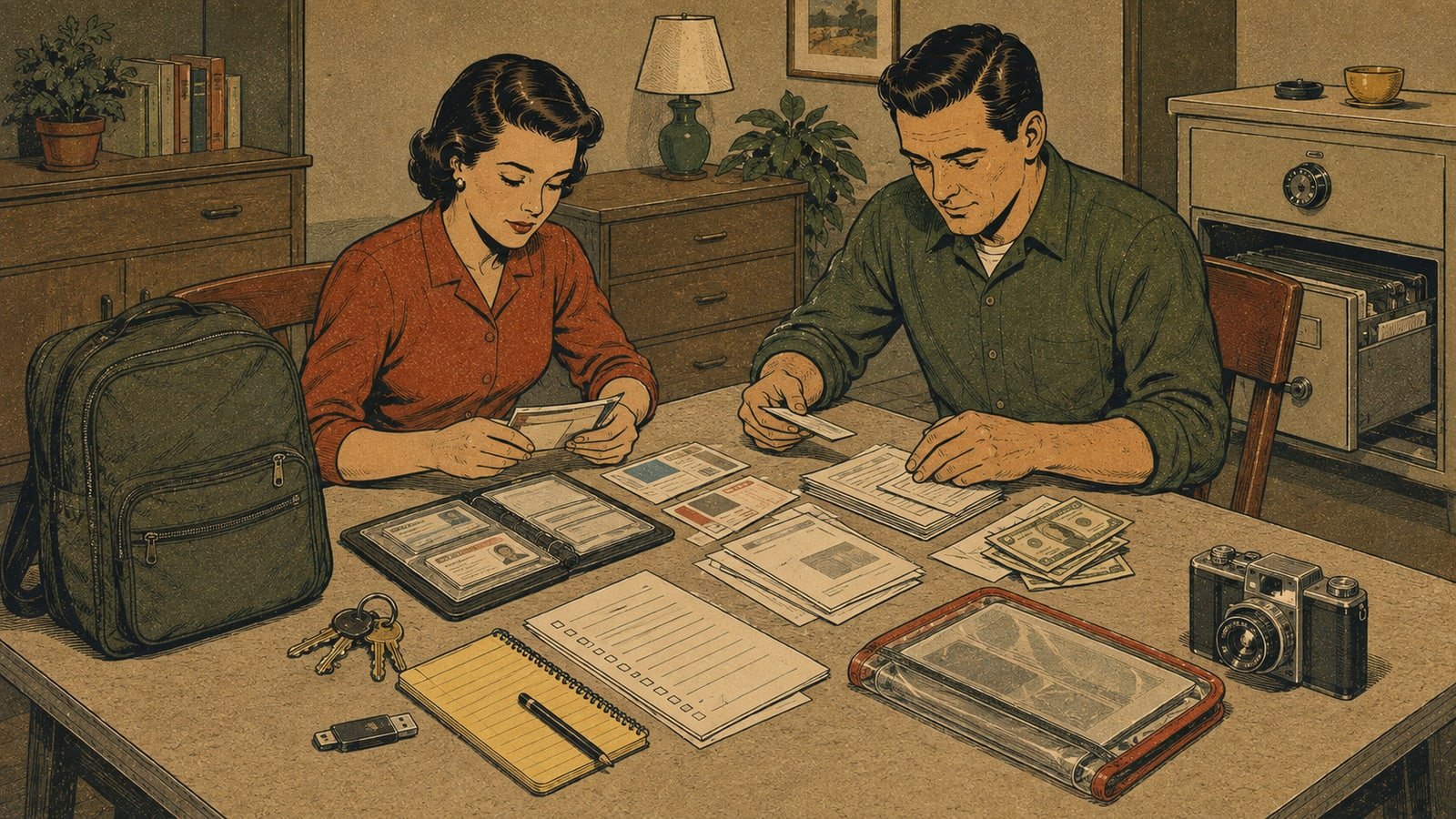
An emergency document kit is not a suitcase of original paperwork. It is a small, protected set of the records and contact details you need to prove identity and occupancy, reach providers, make a claim, continue care, and pay for immediate needs when your normal device or connection is unavailable.
Build it in three layers: a minimal grab pouch, a protected home file, and an encrypted copy stored somewhere else. Add more than one way to pay, plus a modest cash reserve based on your household’s actual short-term needs—not a dramatic pile that creates a new theft risk.
The One-Hour Financial Preparedness Sprint
If the full project feels enormous, do these six jobs first:
- Write the phone number and website for your bank, insurer, property manager or mortgage servicer, employer, pharmacy, and one out-of-area contact.
- Photograph identification, insurance cards, the first page of housing documents, and the front and back of payment cards. Secure the files immediately.
- Photograph every room and major possession, including model and serial numbers when practical.
- Put essential paper copies, a contact sheet, keys, and a small amount of cash in a water-resistant pouch near the household go-bag.
- Create an encrypted off-site backup that a trusted adult can access under the plan.
- Put a six-month review reminder on the calendar.
That first pass is not perfect, but it is useful. Improve it category by category instead of waiting for a free weekend that never arrives.
Build the Document Inventory
Use this as an inventory, not an instruction to carry every original. Mark where each record is stored and when it was last reviewed.
| Category | Useful records or details | Grab copy | Home file | Encrypted off-site |
|---|---|---|---|---|
| Identity | Government ID, passport, birth/adoption records, immigration or citizenship records as applicable | □ | □ | □ |
| Household | Names, contact details, current photos, school or caregiver contacts, pet records | □ | □ | □ |
| Housing | Lease, deed or title, mortgage or rent contact, utility record, property manager | □ | □ | □ |
| Insurance | Policy numbers, insurer and claim contacts, coverage summary, inventory | □ | □ | □ |
| Vehicles | Registration, title location, insurer, roadside contact, identifying details | □ | □ | □ |
| Financial | Bank and card issuers, loan servicers, account identifiers, benefit and income contacts | □ | □ | □ |
| Medical | Insurance cards, medication and allergy list, clinicians, pharmacy, care instructions | □ | □ | □ |
| Legal | Will location, powers of attorney, custody or guardianship documents, attorney contact | □ | □ | □ |
| Recovery | Emergency-management contacts, assistance websites, claim log, receipt envelope | □ | □ | □ |
Do not place full passwords, card security codes, private keys, and every identity record on one unencrypted sheet. A contact number and partial account identifier may be enough to start a conversation with a provider, which can then verify identity through its own process.
FEMA and the Consumer Financial Protection Bureau’s Emergency Financial First Aid Kit provides a much more detailed inventory. Use it as the long-form workbook; use the table above to see whether your three storage layers exist.
Use a Three-Copy Storage Plan
No single container protects against every event. Accessibility, fire, water, theft, device failure, and account lockout pull in different directions.
1. Minimal Grab Pouch
Keep protected copies of the highest-value records with the go-kit: identification, health and medication information, household contacts, housing proof, policy and provider contacts, a paper payment-contact list, and any essential legal instruction. Add keys and a little cash.
The pouch should be water resistant, portable, discreet, and easy for an authorized household member to locate. It should not contain the only copy of anything irreplaceable.
2. Protected Home File
Store originals and fuller records in a secure container appropriate to the risks at your address. “Fire resistant” and “water resistant” are specific product claims with test limits, not magic properties. Read the container’s rating and instructions, protect papers from water within it, and keep the key or combination accessible to the people who should have it.
A bank safe-deposit box may suit records that are rarely needed, but access can depend on the branch being open and the authorized person being available. Do not put the only copy of something needed immediately into a location you may not reach.
3. Encrypted Off-Site Copy
Store an encrypted copy away from the home: a reputable cloud service, a protected drive held elsewhere, or another arrangement the household understands. Use a strong unique password, multifactor authentication, current recovery methods, and device encryption.
Test recovery once. A backup you cannot decrypt, a cloud account tied to a lost phone, or a drive nobody remembers is not a working copy. The preparedness OPSEC guide covers information minimization and household access rules.
Make a Cash Plan Without Picking an Arbitrary Number
The FDIC recommends considering a small amount of cash because ATMs and card systems may be unavailable. “Small” depends on the household, local prices, transport, and how long electronic payments might be interrupted.
Use this planning equation:
Cash reserve = likely cash-only essentials per day × planning days + one transport or lodging buffer
For example, if a household estimates $35 per day for cash-only food, local transport, and incidentals for three days, plus a $120 transport buffer, its planning figure is:
$35 × 3 + $120 = $225
That is a worked example, not a recommendation. Replace every number with local, household-specific estimates. A person who relies on taxis, has several pets, or lives far from the next safe town may reach a different result.
- Favor useful small denominations so a seller does not need to make change.
- Keep cash dry, secure, discreet, and divided between authorized adults rather than in one obvious bundle.
- Count it privately during the six-month review and replace damaged currency through the appropriate financial institution.
- Do not keep money in a vehicle long term or reveal the amount or location outside the household plan.
- Balance outage access with theft, fire, and loss risk. Cash at home is not insured by FDIC deposit insurance.
Add Payment and Account Redundancy
Map the points where normal access could fail:
| Failure | Backup to arrange now |
|---|---|
| Phone is lost or dead | Paper provider contacts, charging plan, tested account recovery |
| Mobile network is congested | Physical card, cash, offline contact sheet |
| Primary card is declined | A second payment method kept separately |
| Local branch is closed | Online/phone access and another reachable branch or ATM network |
| Mail cannot reach the home | Plan for forwarding and provider contact updates |
| Income or benefits are delayed | Emergency savings and current employer/benefit contacts |
| Bill will be late after a disaster | Contact the lender or provider promptly and get any arrangement in writing |
Do not assume a company will automatically know you were displaced or waive a deadline. CFPB advises people recovering from a disaster to contact lenders and account providers, explain the situation, and ask what assistance, fee relief, repayment changes, or document flexibility may be available. Terms vary; record the date, representative, reference number, and exact agreement.
Create a Useful Home Inventory
A slow video of each room is better than no record, but a claim-ready inventory is easier to use.
- Start with wide photos showing the room and its contents.
- Add close photos of high-value or specialized items.
- Record brand, model, serial number, approximate purchase date, and receipt or appraisal location when available.
- Include closets, storage spaces, tools, accessibility equipment, hobby equipment, and items away for repair.
- Save the inventory with the encrypted off-site records and update it after major purchases or disposal.
Do not exaggerate values or create receipts after the fact. The purpose is an accurate record. Ask the insurer what form of inventory and proof it accepts, and review deductibles, exclusions, limits, and replacement-versus-current-value terms directly with the insurer. Renters should confirm how their belongings and temporary living costs are treated rather than assuming the property owner’s policy covers them.
If you live in a rental or shared building, pair this file with the apartment and renter emergency plan. It includes building contacts, exits, shared-system failures, and proof-of-occupancy planning.
Keep a Recovery Log
After everyone is safe, open a paper notebook or offline note and record:
- Event date, address, and evacuation or displacement dates.
- Insurer, bank, lender, landlord, employer, and assistance contacts.
- Each call or message: date, time, person, reference number, promise, and next deadline.
- Photos and videos taken before cleanup, with a simple room or location label.
- Expenses and receipts for lodging, transport, food, supplies, cleanup, repairs, and storage.
- Items discarded, repaired, or replaced and why.
- Copies of estimates, contracts, claim submissions, and decisions.
Back up the log and keep originals of important receipts. Photograph thermal-paper receipts because they can fade. Do not sign a repair contract or transfer benefits under pressure; verify the business and understand the document first.
Slow Down Disaster Scams
Emergencies create urgency, unfamiliar contacts, and public records—all useful to scammers. Use a deliberate verification rule:
- Stop an unsolicited call, text, email, or doorstep conversation without sharing personal or financial information.
- Find the agency, insurer, bank, charity, or contractor through an official site, statement, or known number—not the link or caller ID provided.
- Call back through that independent channel and verify the person, claim, offer, and payment instructions.
- Get scope, price, schedule, license information, and cancellation terms in writing before authorizing work.
- Refuse pressure to pay immediately by wire transfer, gift card, cryptocurrency, or another hard-to-reverse method.
The FTC’s post-disaster scam guidance warns about unlicensed contractors and recommends written contracts and independent checks. The FDIC likewise cautions against unsolicited offers and requests for personal or financial information after a disaster.
If sensitive records or account access are lost, contact the affected providers through verified channels. Monitor transactions and credit as appropriate, change exposed credentials, and use IdentityTheft.gov if identity information is misused.
The Six-Month Review
Use one recurring date—daylight-saving changes, a birthday month, or the start of local hazard season—to check:
- Identification and household photos are current.
- Addresses, phone numbers, account providers, beneficiaries, and authorized people have not changed.
- Medication, allergy, care, school, pet, and vehicle records are current.
- Insurance declarations, inventory, receipts, and housing records are available.
- Cash is present, dry, discreet, and still fits the household estimate.
- The encrypted backup opens, multifactor authentication works, and recovery methods are current.
- Everyone who should access the kit can do so; everyone else cannot.
Then close the file. Financial preparedness should reduce stress, not become a second career.
Sources and Further Reading
- Consumer Financial Protection Bureau — Get Prepared Before a Disaster or Emergency Strikes (modified July 23, 2026)
- Consumer Financial Protection Bureau — Start Recovering and Rebuilding Your Financial Life
- CFPB and FEMA — Your Disaster Checklist
- FEMA and Operation HOPE — Emergency Financial First Aid Kit
- FDIC — Preparing Your Finances for an Unanticipated Disaster (updated August 26, 2025)
- FDIC — Natural Disaster Impact: Advice for Consumers and Business Owners (updated October 9, 2024)
- Federal Trade Commission — How to Avoid Scams After Weather Emergencies and Natural Disasters