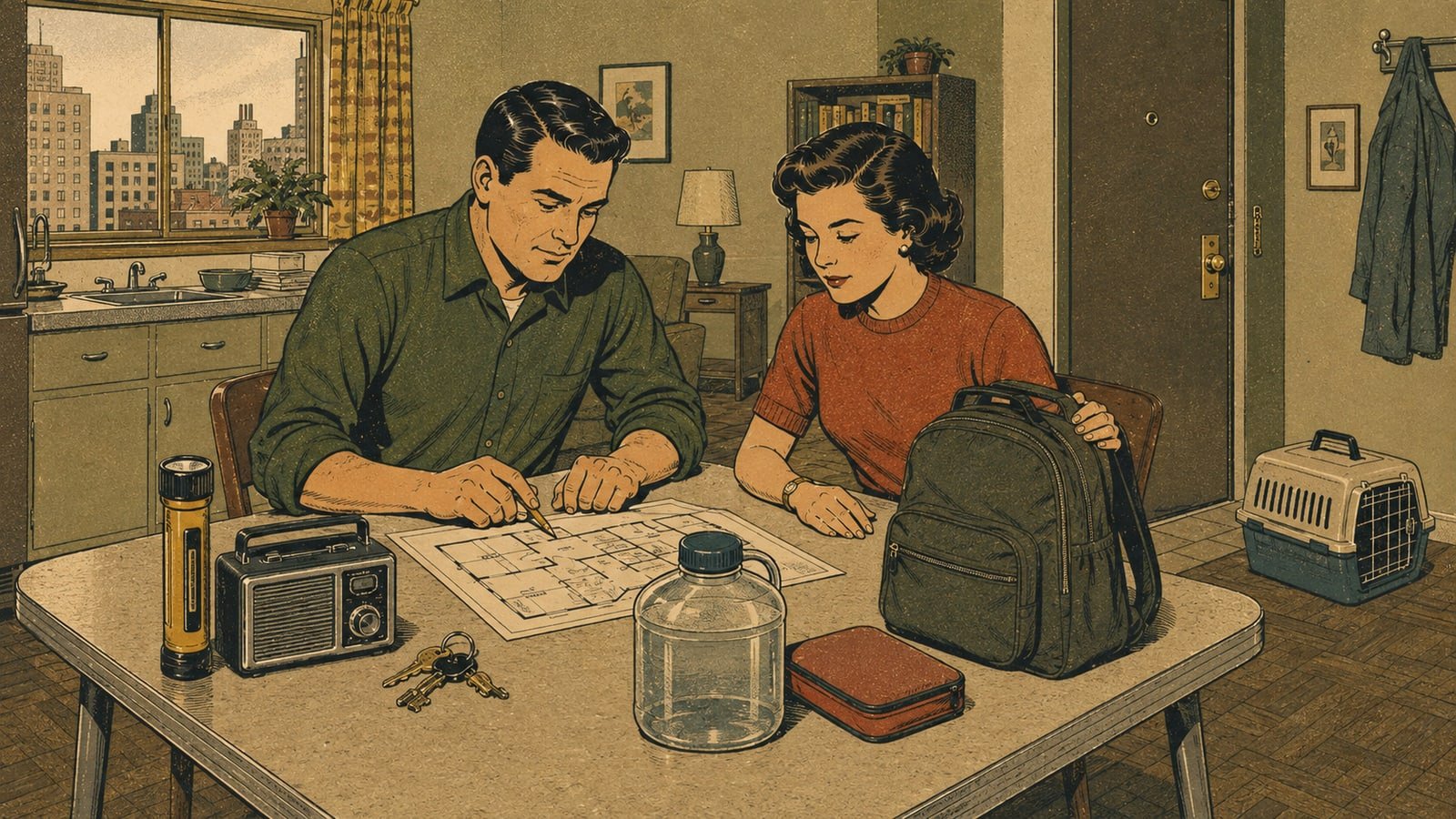
Apartment preparedness is less about owning a basement full of equipment and more about knowing how your building works. You share hallways, stairs, alarms, utilities, and decisions with other people. An elevator can stop, a locked garage can trap a vehicle, and a perfectly packed kit can be useless if it sits behind the only blocked exit.
Start with a one-page plan, one portable kit, and a realistic place to go. You can build all three in a small home without modifying the property or turning the living room into a warehouse.
The 30-Minute Apartment Preparedness Plan
Do this walkthrough with every roommate or household member. Photograph the finished page and share it with your out-of-area contact.
| Decision | Find or choose this now | Your answer |
|---|---|---|
| Building alerts | Text, app, intercom, alarm, email, or manager phone tree | ______ |
| Primary exit | Nearest safe stair or ground-level exit | ______ |
| Backup exit | A different stair or exterior route | ______ |
| Fire meeting place | A visible spot outside and away from responding vehicles | ______ |
| Neighborhood meeting place | A walkable location if the block is closed | ______ |
| Out-of-area contact | One person everyone can message | ______ |
| Building contact | Manager, owner, front desk, or maintenance emergency number | ______ |
| Accessible help | Person and backup who understand the assistance requested | ______ |
| Pet plan | Carrier or leash location and one temporary destination | ______ |
| Transport backup | A person, transit option, or accessible transport contact | ______ |
| Utility controls | What tenants may operate and what building staff controls | ______ |
| Go-kit location | Reachable on the way to the safest exit | ______ |
Do not guess about building systems. Ask management which alarms are building-wide, where residents should assemble, whether exterior doors unlock during an outage, what happens to water pressure, and how residents who cannot use stairs should request help. Report blocked exits, damaged closers, dead emergency lights, or faulty alarms rather than trying to repair shared safety equipment yourself.
Separate the Fire Plan From Every Other Plan
The same building can require opposite actions in different emergencies. A hallway that is useful during an evacuation may be dangerous when it contains smoke. A windowless interior room that helps during severe weather may be wrong for a chemical release if officials give different instructions.
| Situation | First source of direction | Default planning assumption |
|---|---|---|
| Fire or smoke | Building alarm, fire plan, 911, and firefighters | Use a safe stair route; never plan on the elevator |
| Evacuation order | Local emergency alerts and officials | Leave by the route and time officials specify |
| Severe weather | Local weather service and emergency alerts | Move to the location recommended for that hazard |
| Chemical release | Emergency alerts and public-safety instructions | Be ready to close outside-air pathways and shelter only as directed |
| Utility outage | Utility and building management notices | Confirm which shared systems still work before deciding to stay |
The U.S. Fire Administration’s high-rise guidance tells residents to know all exit stairs, leave by the stairs when the route is safe, close the apartment door, go to the outside meeting place, and tell firefighters if someone remains inside. Practice that route in normal conditions. Count the doors between your apartment and the nearest stair so you have another way to orient yourself if visibility is poor.
If fire or smoke prevents you from leaving, do not push through a dangerous corridor. Call 911, give your building address, unit, floor, and exact situation, close the door between you and the fire, and follow the dispatcher’s instructions. Plan ahead with building management and your local fire department if anyone in the household cannot use the stairs independently.
Map the Building, Not Just the Apartment
Walk the route instead of trusting the evacuation diagram from memory.
- Find two ways out of each sleeping area when the building design allows it, plus the nearest two usable exit stairs from your floor.
- Follow each stair to its actual outside discharge. Some stairs end in a lobby or unfamiliar side of the building.
- Locate manual fire-alarm pulls, extinguishers, emergency phones, and posted refuge or assistance areas without blocking or tampering with them.
- Check whether a fob, key, or powered garage door affects your exit. Keep physical keys where you can grab them in darkness.
- Choose a meeting place that does not obstruct the entrance, hydrants, fire lanes, or arriving crews.
- Learn where household members will reconnect if they evacuate from different floors, work, school, or transit.
Then look inward. Keep the path from beds to the door clear. Avoid storage that narrows a hall or blocks a window. Secure tall furniture only with methods allowed by the lease and suitable for the wall construction; get written permission when an alteration requires it. The goal is a usable exit, not an argument over a security deposit after the shelves fall over.
Build a Small-Space Supply System
Do not force every emergency item into one enormous bag. Use three layers based on how you would actually use them.
Layer 1: The Exit Kit
Keep a portable 72-hour go-bag near the normal path out, but out of public view. It should be light enough for its user to carry while using stairs. Include:
- Water, compact food, a flashlight or headlamp, radio, power bank, charging cables, and weather protection.
- Essential medication and medical information, following storage instructions from the pharmacist or manufacturer.
- Copies of identification, the lease or proof of occupancy, insurance contacts, and a short household contact sheet.
- A spare physical key, a little cash in useful denominations, and a paper transit or neighborhood map.
- Needed glasses, hearing-aid batteries, communication aids, mobility supplies, or other everyday support items.
- Pet leash, carrier, medication, waste bags, identification, and a recent photo with the owner.
Give each person a realistic carry limit. A household can split shared gear rather than building duplicate forty-pound bags.
Layer 2: The Stay-Home Supply
Use low, stable, accessible spaces: under a bed, the back of a closet, or a lidded shelf. Spread weight rather than stacking all water high on one rack. Keep water away from chemicals and inspect it on a schedule. The grid-down water guide covers clean containers, utility notices, and household-source triage.
Add shelf-stable food that needs little water or cooking, sanitation supplies, spare batteries, first aid, blankets appropriate to the climate, and whatever your household uses every day. Avoid indoor combustion devices. A grill, camp stove, or generator does not become safe indoors because the balcony is small or the weather is bad.
Layer 3: The Grab Folder
Keep a compact waterproof pouch or encrypted digital copy with the records you would need after displacement. FEMA’s Emergency Financial First Aid Kit includes leases, housing payments, account contacts, identification, insurance, and medical information. Store only what you need, protect sensitive data, and make sure another trusted household member knows how to access it.
Plan for Shared Systems to Fail
Ask what happens in your specific building rather than assuming every apartment loses the same services.
Power and Elevators
An outage may affect elevators, door access, garage gates, corridor lights, water pumps, heating, cooling, and communication systems differently. If a household member depends on an elevator or powered medical equipment, make a plan with building management, the equipment provider, the clinician, and local emergency services before an outage. A consumer power bank is not a universal medical backup. See the off-grid communications guide for a communications ladder that does not depend on one phone or network.
Water and Plumbing
Building water may stop even when neighborhood water service continues, especially where pumps serve upper floors. Follow utility and management notices. Do not drink from building fire-protection systems, boilers, radiators, or decorative water features. If sewage backs up or officials issue a do-not-use notice, stop using affected fixtures and wait for qualified local direction.
Heating and Cooling
Upper floors can become much hotter, while poorly insulated units can cool quickly. Decide in advance where you will go if the apartment cannot maintain a safe temperature. Never heat an apartment with an oven or unapproved fuel-burning device. During cold-weather outages, use the staged checks in the winter power-outage guide.
Entry and Security
Know how to lock and unlock the unit without electricity. Keep the management emergency number on paper. Do not prop open fire doors or shared exterior doors to make re-entry convenient; that trades one problem for a building-wide safety and security risk.
Make Roommates and Neighbors Part of the Plan
A group chat is useful, but it is not an accountability system unless everyone knows what messages mean.
- Agree on one short message format: name, location, status, and next action. For example: “Maya — outside at library — safe — staying there.”
- Name an out-of-area contact who can collect updates if local calls are congested.
- Decide whether anyone will check a neighbor, and only if it can be done without delaying evacuation or entering danger.
- Share access instructions only with trusted people and with the resident’s consent.
- Never assume that an older person or disabled person needs the same help as someone else. Ask what assistance they want, how to provide it, and what backup is acceptable.
CDC recommends a personal support network that can include neighbors and roommates, plus a plan containing important contacts and individual care instructions. Its access-focused preparedness guidance also recommends planning for evacuation assistance and checking halls and stairs for hazards. If accessible transportation may be needed, identify the local provider and a backup before an emergency; availability can change during the event.
Protect the Recovery Paper Trail
Preparedness continues after everyone is safe. A renter may need to prove occupancy, document damaged belongings, contact the insurer, reach the property owner, or pay for a few days away from home.
- Photograph each room and valuable item before a disaster, and update the inventory after major purchases.
- Save the lease, identification, insurance policy and claim number, property-manager contact, medication list, and pet records in protected physical and digital forms.
- Review what the renter’s policy does and does not cover with the insurer; do not assume the building owner’s coverage protects tenant belongings.
- Record damage only from a safe place. Do not re-enter until officials or building management say it is safe.
- Keep receipts for emergency lodging, transport, food, supplies, and other displacement expenses in case an insurer or assistance program requests them.
Avoid posting keys, unit numbers, access codes, full documents, or a detailed inventory publicly. A recovery record should make a claim easier, not make the home easier to target.
A Realistic Apartment Drill
Run this twice a year, after moving, and whenever the household or building plan changes.
- Sound a phone timer rather than activating the building alarm.
- Put on shoes, pick up keys and the exit kit, and move toward the primary stair route.
- Stop before interfering with neighbors or building operations; do not open alarmed exits merely for practice without permission.
- Walk the approved route to the meeting place, then identify the backup route from the outside.
- Send the agreed status message to the household test group.
- Time the process only to find friction, not to encourage running.
- Fix one failure immediately: a blocked path, dead battery, missing key, bag that is too heavy, or contact who did not know the plan.
The best plan is not the most elaborate one. It is the plan everyone can find, carry, understand, and repeat when the lights are out and the elevator is not an option.
Sources and Further Reading
- U.S. Fire Administration — Home Fire Escape Plans (reviewed April 10, 2025)
- U.S. Fire Administration — Protecting People Who Live or Work in High-Rises (reviewed May 1, 2026)
- U.S. Fire Administration — Apartment Fire Safety
- CDC — Improve Access (April 18, 2024)
- CDC — Building an Emergency Kit for Individual Needs (September 11, 2024)
- CDC — Sheltering and Evacuating (September 11, 2024)
- FEMA and Operation HOPE — Emergency Financial First Aid Kit