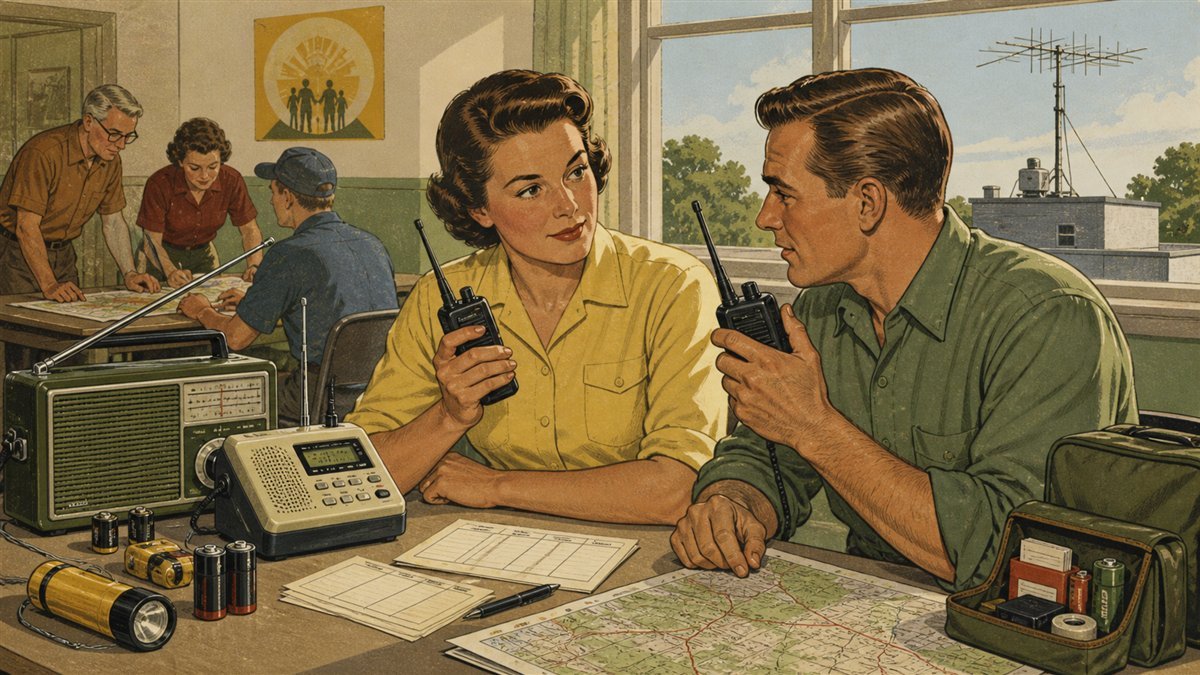
Emergency communication is a ladder, not one magic radio. Start with official alerts and household contacts, then add tools that match distance, terrain, licensing, power, and the people who will actually practice with them.
Radio range claims are not planning distances. Hills, buildings, antenna height, frequency, interference, power, weather, and repeater status can change coverage dramatically. Test every route locally.
Build the Ladder
- Official alerts: Wireless alerts, local emergency management, and broadcast radio
- Household: Text, calls, messaging, and an out-of-area contact
- Nearby: FRS or another lawful personal-radio service
- Community: GMRS or amateur radio with the required license and training
- Remote areas: Satellite messenger with an active plan and clear sky
- No electronics: Written meeting points, time windows, and message locations
The FCC Personal Radio Services page is the starting point for current FRS, GMRS, MURS, CB, and related rules. Equipment approved for one service is not automatically lawful on another merely because it can be programmed there.
FRS, GMRS, and MURS
FRS
FRS uses certified, limited-power handheld radios under FCC rules without an individual license. It is useful for short-range household coordination. Channels are shared and conversations are not private.
Midland FRS/GMRS Handheld Radios
Product example only. Verify current specifications, compatibility, safety instructions, price, and availability before buying.
⚠ Affiliate link — we earn a small commission at no extra cost to you.
GMRS
GMRS generally requires an FCC license. Some repeaters can extend coverage, but access, tones, availability, and outage power are local. Confirm current eligibility, license term and fee directly with the FCC before transmitting.
Midland GMRS Mobile Radio
Product example only. Verify current specifications, compatibility, safety instructions, price, and availability before buying.
⚠ Affiliate link — we earn a small commission at no extra cost to you.
MURS
MURS is a license-by-rule service with a small set of VHF channels and service-specific equipment and operating limits. It is not private or interference-free. Check the current FCC rules before buying programmable equipment.
Amateur Radio
Amateur radio requires an FCC operator license for ordinary transmitting. Privileges depend on license class, band, mode, and rules. Emergency conditions do not make routine unlicensed practice legal; train and license beforehand.
Baofeng UV-5R Handheld Radio
Product example only. Verify current specifications, compatibility, safety instructions, price, and availability before buying.
⚠ Affiliate link — we earn a small commission at no extra cost to you.
Yaesu FT-60R Handheld Amateur Radio
Product example only. Verify current specifications, compatibility, safety instructions, price, and availability before buying.
⚠ Affiliate link — we earn a small commission at no extra cost to you.
See amateur radio for emergency preparedness for licensing, practice, and net etiquette.
Satellite Messengers
Satellite messengers can provide check-ins or SOS outside cellular coverage, but they require device registration, a compatible subscription, charged batteries, current firmware, and a view of the sky. Message delivery can be delayed or fail in canyons, dense cover, buildings, and severe weather.
Garmin inReach Mini Satellite Communicator
Product example only. Verify current specifications, compatibility, safety instructions, price, and availability before buying.
⚠ Affiliate link — we earn a small commission at no extra cost to you.
An SOS button is not a substitute for an itinerary, local emergency number, first aid, or knowing when to turn back.
Receive-Only Information
NOAA Weather Radio broadcasts official warnings from a nationwide transmitter network. Coverage and reception vary, so use the National Weather Service station information to identify local frequencies and test reception where you shelter.
Midland NOAA Weather Alert Radio
Product example only. Verify current specifications, compatibility, safety instructions, price, and availability before buying.
⚠ Affiliate link — we earn a small commission at no extra cost to you.
Shortwave receiving can add distant broadcasts, but schedules and credibility vary. Cross-check urgent claims with official sources.
Write and Test the Plan
- Assign primary, backup, and out-of-area contacts.
- Write call signs, channels, tones, and check-in times without publishing them broadly.
- Use plain language and short transmissions; never imply encryption or privacy where none exists.
- Keep spare approved batteries and a safe battery-power plan.
- Test from actual homes, shelters, routes, and meeting points twice a year.
- Update licensing, subscriptions, firmware, contacts, and frequencies.