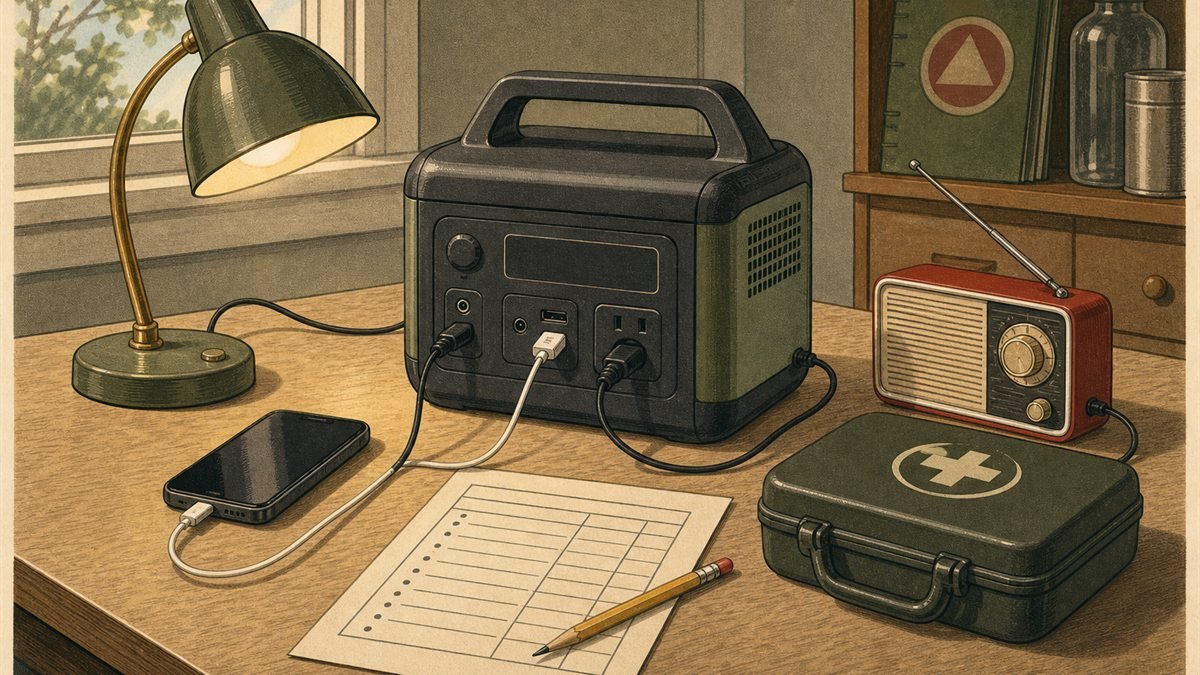
A portable power station combines a rechargeable battery, charger, inverter, and outlets. It can operate indoors without combustion exhaust, but it is not unlimited energy and lithium batteries introduce fire, charging, and disposal hazards.
Begin with measured loads and a charging plan. Brand comparisons and advertised phone charges are secondary.
Calculate Energy and Power Separately
Power (watts) is the instantaneous load. The station’s continuous output must exceed the simultaneous running load, and its surge rating must cover motor or compressor starting demand.
Energy (watt-hours) is runtime. A first estimate is:
usable watt-hours ÷ measured device watts = hours
Usable energy is less than labeled capacity because of inverter loss, battery-management reserve, temperature, battery age, and device behavior. Do not apply one fixed efficiency percentage to every station.
Measure devices over a realistic cycle. A refrigerator or CPAP does not necessarily draw its label maximum continuously, while heaters and kettles can consume a small battery very quickly. For life-sustaining equipment, ask the equipment provider about compatible backup power, alarms, humidifier/heater loads, and emergency alternatives.
Compare the Right Specifications
- Battery capacity in watt-hours, not only marketing “charges”
- Continuous and surge AC output
- DC and USB outputs needed by the actual devices
- AC and solar input voltage/current limits
- Battery chemistry and manufacturer-stated cycle test conditions
- Operating, charging, and storage temperature ranges
- Independent safety listing for the complete product where available
- Replaceable batteries, warranty, repair, firmware, and recall support
- Whether pass-through use or an uninterruptible mode is actually supported
Lithium iron phosphate (LFP) and nickel-manganese-cobalt (NMC) products have different weight, energy density, longevity, and thermal characteristics, but chemistry alone does not establish product safety. Cell quality, battery management, enclosure, charger, testing, and correct use all matter.
EcoFlow RIVER 2 Portable Power Station
Product example only. Verify current specifications, compatibility, safety instructions, price, and availability before buying.
⚠ Affiliate link — we earn a small commission at no extra cost to you.
Jackery Explorer Portable Power Station
Product example only. Verify current specifications, compatibility, safety instructions, price, and availability before buying.
⚠ Affiliate link — we earn a small commission at no extra cost to you.
BLUETTI AC200P Portable Power Station
Product example only. Verify current specifications, compatibility, safety instructions, price, and availability before buying.
⚠ Affiliate link — we earn a small commission at no extra cost to you.
Use and Charge Safely
The CPSC tracks fire, burn, overheating, and explosion hazards in high-energy batteries. Follow the exact manufacturer manual and these baseline precautions:
- Use only approved chargers, cables, and solar input within the specified voltage and current window.
- Charge on a stable surface with required ventilation, away from exits and combustible materials.
- Keep the unit dry and within its operating-temperature range.
- Do not cover vents, daisy-chain power strips, or exceed any outlet/circuit limit.
- Stop using a unit that is swollen, cracked, leaking, unusually hot, odorous, smoking, or recalled.
- Do not open or repair a battery pack unless the manufacturer provides an authorized service process.
- Keep children away and protect cords from damage and trips.
If a battery is smoking or on fire, evacuate, call emergency services, and follow dispatcher instructions. Damaged or recalled lithium batteries require specialized disposal; contact the manufacturer and local household-hazardous-waste program before transport.
Build a Real Charging Plan
Wall charging before a forecast event is simplest. Vehicle charging depends on the vehicle outlet and should not drain the starting battery or run a combustion engine in a garage. Solar charging varies with season, clouds, shade, temperature, orientation, controller limits, and panel compatibility.
No portable solar setup is “indefinitely rechargeable” without sufficient sun, working components, and energy balance. Use solar-power planning and model the worst relevant month.
For multi-day outages, reduce demand before adding batteries:
- Use direct DC/USB outputs where supported to avoid inverter loss.
- Charge phones in batches and use low-power mode.
- Keep refrigerator doors closed and verify food temperature.
- Use blankets and clothing instead of electric resistance heat.
- Rotate loads so starting surges do not overlap.
Storage and Testing
The correct storage charge and inspection interval depend on the product. Follow the manual rather than a universal 50% rule. Store within the listed temperature range, away from moisture, ignition, and escape paths.
At least on the manufacturer’s maintenance schedule:
- Check the product and charger for damage or recalls.
- Charge as directed.
- Run the actual critical load and record energy used.
- Confirm alarms, automatic shutdown, and cable fit.
- Update the written runtime and recharge plan.
Compare combustion backup in the generator safety guide and keep communications efficient using the off-grid communications guide.