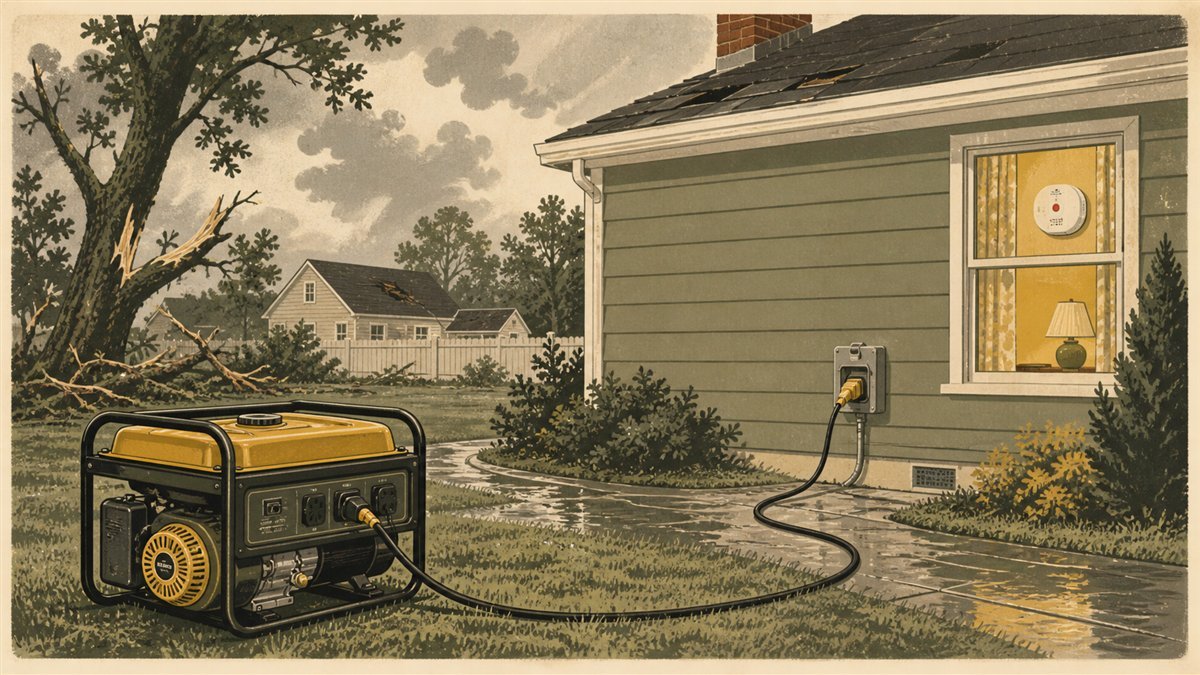
A portable generator should be sized from the loads you have measured, not from a whole-house guess. Before buying one, identify a legal outdoor operating position more than 20 feet from doors, windows, and vents, decide whether loads will use direct cords or professionally installed transfer equipment, and calculate both continuous load and the worst credible starting peak.
The safest first step is placement. The CDC says generators belong outdoors, more than 20 feet from doors, windows, and vents. Never operate one in a home, garage, basement, shed, carport, crawlspace, or other enclosed or partly enclosed area—even with doors open. Direct the exhaust away from buildings and keep the unit on a dry surface protected according to its manual.
Build a Measured Load Worksheet
List only the devices that must run during an outage. For each one, record:
- Voltage and running watts from a nameplate, manufacturer documentation, or suitable meter.
- The highest total wattage while that device starts, where a motor or compressor creates a surge.
- Whether it is cord-connected or hardwired.
- How long it needs to run and whether it can be scheduled separately.
A basic plug-in meter may not capture a brief motor-starting peak. Do not open panels or improvise measurements on hardwired equipment. Ask an electrician, HVAC technician, well contractor, or medical-equipment provider for the correct figures.
Worked Example
This fictional household measured or confirmed the following 120-volt loads. The figures are examples—not typical values to copy—and assume the refrigerator and furnace blower will not begin starting at exactly the same instant.
| Critical load | Running watts | Highest total watts while it starts | Plan |
|---|---|---|---|
| Refrigerator | 140 W | 900 W | Cycle normally |
| Furnace blower | 500 W | 1,200 W | Confirm equipment and connection compatibility |
| LED lights, router, and phone charging | 100 W | 100 W | Combined measured load |
| All loads running | 740 W | — | Continuous requirement |
Check both possible motor-starting cases:
- Furnace starts while the refrigerator and small loads are running:
1,200 + 140 + 100 = 1,440 W. - Refrigerator starts while the furnace and small loads are running:
900 + 500 + 100 = 1,500 W.
For this example, the comparison point is at least 740 rated continuous watts and 1,500 surge watts under the intended fuel, temperature, elevation, and manufacturer conditions. Do not buy exactly from this example. Repeat the worksheet with your own measurements, confirm whether a listed “starting watts” value means total or additional watts, and leave capacity for measurement uncertainty and equipment limits.
Choose a Safe Connection Method
The connection plan determines which generator features you need. The CPSC warns never to feed a home through a wall receptacle; a male-to-male cord can leave energized pins exposed, bypass household protection, and backfeed utility lines.
| Need | Appropriate route | Checks before use |
|---|---|---|
| A few compatible plug-in appliances | Plug them directly into generator receptacles with intact, grounded, outdoor-rated cords | Cord amp/watt rating and length, appliance instructions, dry routing, intact three-prong plugs, generator GFCI instructions |
| Selected household circuits or hardwired equipment | Listed transfer equipment and inlet selected and installed by a licensed electrician | Generator output and neutral/ground configuration, permits, grounding/bonding, circuit priorities, operating sequence |
| A manufacturer-specific home-integration system | Only the exact approved equipment and documented configuration | Generator model compatibility, installation instructions, load limits, inspection and maintenance |
| A household receptacle or improvised male-to-male cord | Never use this route | It is backfeeding, not a transfer method |
OSHA’s portable-generator grounding fact sheet explains that grounding and bonding requirements change with the configuration and that a structure connection requires a properly installed transfer switch. Follow the generator and transfer-equipment manuals plus the electrician’s instructions; do not assume adding a ground rod makes an unsafe connection safe.
The CPSC’s portable-generator safety alert calls for heavy-duty outdoor cords whose wattage rating exceeds the connected load. Keep the full cord visible and dry, away from standing water and vehicle traffic, and protect it from cuts, pinching, and crushing without defeating doors or creating an unsafe exit.
Compare Generator Configurations
Inverter Generator
An inverter generator may suit a smaller scheduled-load plan. Compare rated continuous output, surge capability, outlets, fuel use at your measured load, waveform requirements, noise specification, service access, and the exact neutral/ground arrangement required by your connection method.
Honda EU2200i Inverter Generator
Product example only. Verify current specifications, compatibility, safety instructions, price, and availability before buying.
⚠ Affiliate link — we earn a small commission at no extra cost to you.
Dual- or Tri-Fuel Generator
Multiple fuels can improve flexibility, but available output, regulator requirements, hoses, cold-weather behavior, storage rules, and runtime differ by fuel. Propane and natural gas still create carbon monoxide.
Champion Dual-Fuel Portable Generator
Product example only. Verify current specifications, compatibility, safety instructions, price, and availability before buying.
⚠ Affiliate link — we earn a small commission at no extra cost to you.
Permanently Installed Standby Unit
A standby unit needs code-compliant siting, permits where required, professional electrical and fuel installation, approved transfer equipment, and scheduled maintenance. A utility gas connection does not remove supply or outage limitations.
Control Carbon Monoxide Every Time
- Use the outdoor position confirmed before purchase: more than 20 feet from your home and every door, window, or vent, with exhaust directed away. Also consider openings in neighboring occupied buildings.
- Install working battery-powered or battery-backup CO alarms near sleeping areas and wherever the alarm instructions and local code require. Test and replace them on the manufacturer’s schedule.
- Treat automatic CO shutoff as an extra layer, never as permission to operate indoors or closer to a building.
- If a CO alarm sounds or anyone develops headache, dizziness, weakness, nausea, chest pain, or confusion, move everyone—including pets—to fresh air and call emergency services. Do not re-enter until responders say it is safe.
Kidde Carbon Monoxide Alarm
Product example only. Verify current specifications, compatibility, safety instructions, price, and availability before buying.
⚠ Affiliate link — we earn a small commission at no extra cost to you.
Plan Fuel, Refueling, and Maintenance
Store fuel outside living areas in approved, labeled containers, within fire-code, lease, insurance, and local quantity limits. Keep it away from ignition sources, heat, children, and incompatible materials. Follow fuel-specific rules for gasoline, propane, or natural-gas equipment.
Before refueling, turn the generator off, disconnect loads as its manual directs, and let it cool. Fuel spilled on hot engine parts can ignite. Never refuel a running or hot unit.
Follow the manufacturer schedule for oil, filters, spark plugs, batteries, stabilization, storage, and load testing. Check the model for recalls before use. During a supervised drill, record:
- Which loads were connected and which were scheduled.
- Highest observed load and any overload or voltage warning.
- Fuel consumed over a measured number of hours at that load.
- Cord, alarm, transfer, shutdown, cooldown, and refueling steps.
Marketing runtime measured at another load is not your outage fuel plan.
Next Actions
- Mark a compliant outdoor location and confirm that a cord can reach without crossing water, traffic, or an unsafe doorway.
- Complete your own load worksheet and have hardwired or high-surge loads assessed.
- Choose direct cords or obtain an electrician’s transfer-equipment plan before buying.
- Test CO alarms and run a supervised household drill with the written shutdown sequence.
- Build complementary plans for battery power stations, solar recharging, cooking without utility power, and winter power outages so the generator is not your only option.