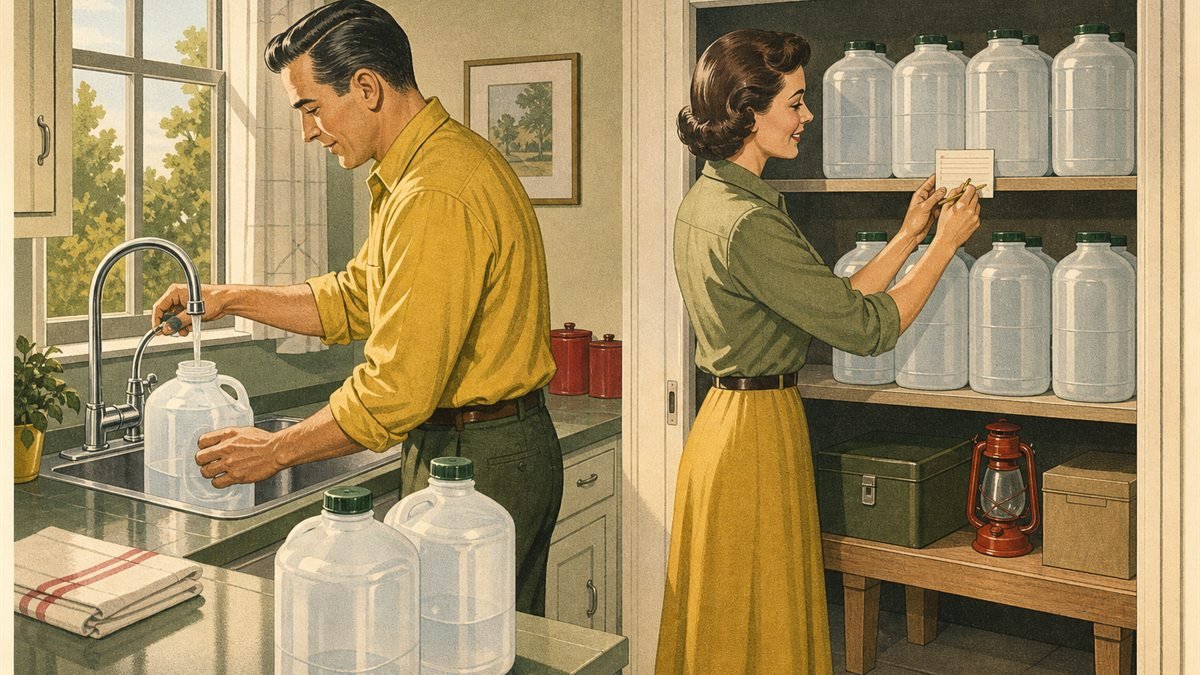
When a utility warns of a shutoff, main break, or contamination event, the first instruction is not always “fill everything.” Follow the water utility and health department: water can remain pressurized yet be unsafe, and some chemical incidents require avoiding tap water entirely.
If officials say the tap water is safe but service may stop, capture it in clean food-grade containers. If the notice is a boil-water or do-not-use advisory, follow its exact scope and use bottled or otherwise approved water.
Before an Outage: Store the Baseline
The CDC recommends at least 1 gallon per person per day for 3 days and suggests trying for 2 weeks. Commercially bottled water is the safest emergency supply. Self-filled water belongs in sanitized, food-grade containers and should be replaced every 6 months.
Use the calculator and sanitation steps in long-term household water storage. Advance storage removes the temptation to use a questionable source when a warning arrives.
If Safe Tap Water Is Still Available
- Confirm the current utility notice and whether the water is safe to collect.
- Wash and sanitize food-grade containers before filling.
- Fill portable containers first and close them without touching the inside.
- Label each container with the fill date and intended use.
- Fill a bathtub bladder only if its instructions allow and you can keep the inlet and cap clean.
Water held directly in a household bathtub is vulnerable to residues, drains, hands, and pets. Treat it as nonpotable sanitation water unless public-health guidance and an appropriate treatment process establish otherwise.

WaterBOB Emergency Bathtub Water Storage
Product example only. Verify current specifications, compatibility, safety instructions, price, and availability before buying.
⚠ Affiliate link — we earn a small commission at no extra cost to you.
Inventory Safer Household Sources
The CDC lists several possible emergency sources:
- Commercially bottled water
- Uncontaminated ice made before the incident
- Liquid from canned fruit or vegetables
- Water from the home’s drinking-water heater, if officials have not said the public system is contaminated
- Water from a clear toilet tank that has no chemical cleaner, if the system has not been declared contaminated
Do not use water from a home-heating boiler. Pool and spa water may be useful for cleaning or flushing, but the CDC says not to drink it.
Water-Heater Safety
A tank water heater may contain a useful volume, but draining procedures vary. Water can be scalding, sediment can block valves, and energizing an empty electric tank can destroy it or start a fire.
- First confirm that the utility has not reported chemical or system contamination.
- Shut off electrical power or fuel according to the manufacturer’s emergency instructions.
- Let hot water cool and keep children away.
- Follow the manufacturer or a licensed plumber’s drain procedure; do not improvise with the pressure-relief valve.
- Refill and purge the tank completely before restoring power.
Allocate Water Without Creating New Risks
| Priority | Use | Planning note |
|---|---|---|
| 1 | Drinking and clinician-directed medical use | Use potable water; stored water is not sterile |
| 2 | Food preparation | Follow boil-water-advisory instructions |
| 3 | Hand hygiene | Use safe water and soap, or an appropriate sanitizer when hands are not visibly dirty |
| 4 | Essential cleaning | Match water quality to the task |
| 5 | Flushing | Use nonpotable water if plumbing officials say sewer service is working |
Do not use ordinary stored drinking water where a medical product specifically requires sterile water or sterile saline. Follow the product label or clinician’s directions.
Track inventory daily:
usable gallons ÷ household daily allocation = estimated days remaining
The 1-gallon baseline may need to increase for heat, pregnancy, illness, physical work, pets, or other needs. Reduce avoidable washing and flushing before cutting drinking water.
If the Supply Runs Low
Use official distribution points and known safe neighbors or family plans before turning to surface water. Do not enter abandoned buildings or take private water supplies.
Potential sources each need their own risk assessment:
- Rainwater: Prefer nonpotable uses; test and treat for intended potable use. See rainwater harvesting.
- Streams and lakes: Assume germs are present and evaluate upstream chemical hazards.
- Private wells: A powered pump and safe test history are both required; flooding changes the risk.
- Pool or spa: Reserve for cleaning or flushing, not drinking.
For microbial hazards, boiling is the best germ-control method. If boiling is not possible, filtration followed by disinfection is generally the next-best approach. Most portable filters do not remove viruses, and no ordinary field process makes fuel- or chemical-contaminated water safe. Review water-purification methods compared.

Sawyer MINI Water Filtration System
Product example only. Verify current specifications, compatibility, safety instructions, price, and availability before buying.
⚠ Affiliate link — we earn a small commission at no extra cost to you.

Aquatabs Water Purification Tablets
Product example only. Verify current specifications, compatibility, safety instructions, price, and availability before buying.
⚠ Affiliate link — we earn a small commission at no extra cost to you.
Outage Checklist
- Save utility, health-department, and emergency-management alert sources.
- Store the baseline supply before hurricane, winter-storm, or wildfire season.
- Keep printed container-sanitation and emergency-treatment instructions.
- Know how to shut down the water heater safely.
- Keep clean and dirty containers clearly separated.
- Recheck advisories before using tap water after service returns.