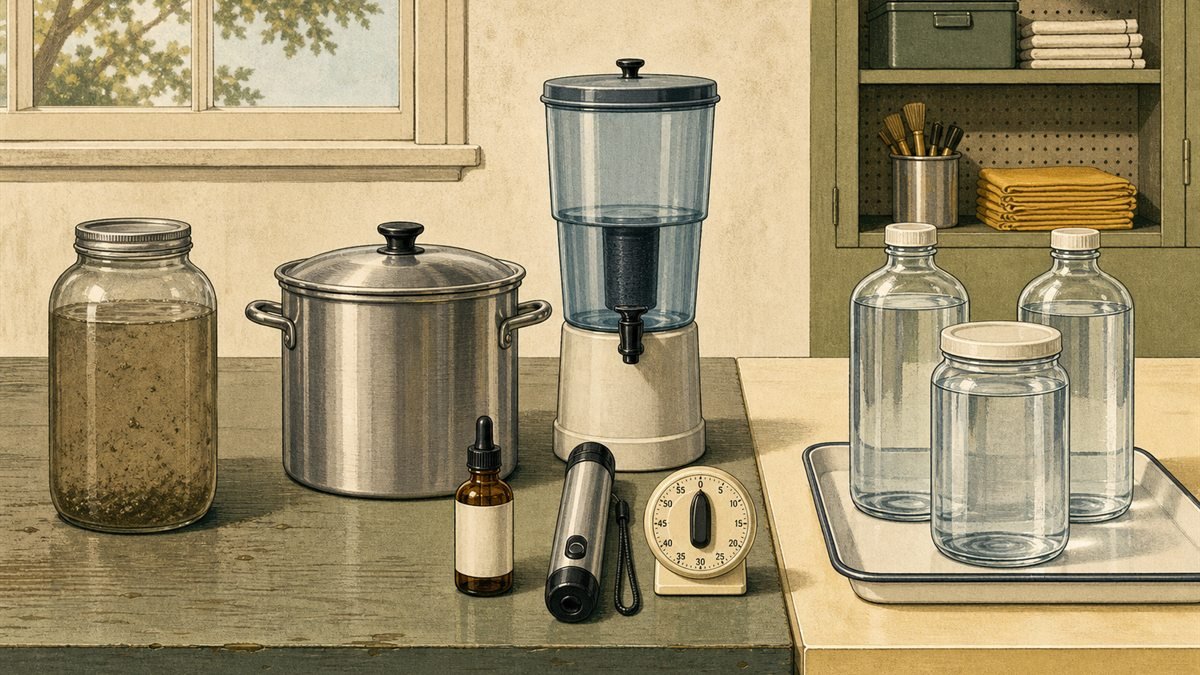
Water treatment is not one universal process. Boiling, portable filters, disinfectants, ultraviolet devices, and distillation address different hazards. The safest choice starts with the source and the contaminants that may be present.
If a public-water advisory is in effect, follow the water utility or health department’s instructions. If fuel, pesticides, toxic chemicals, radioactive material, or a suspicious odor may be involved, use another water source: the CDC warns that boiling or disinfection will not make chemically contaminated water safe.
Identify the Threat First
| Hazard | Examples | Key limitation |
|---|---|---|
| Parasites | Giardia, Cryptosporidium | Some disinfectants work poorly against Cryptosporidium |
| Bacteria | E. coli, Salmonella | Many portable microfilters can remove them if used to their rating |
| Viruses | Norovirus, hepatitis A | Many backpacking filters do not remove viruses |
| Chemicals and salts | Fuel, pesticides, lead, seawater | Boiling and ordinary disinfection do not remove them |
Clear water can still contain disease-causing organisms. According to the CDC’s backcountry-water guidance, boiling is the best germ-control method; when boiling is not possible, the next-best approach is usually filtration followed by disinfection.
Boiling
Boiling kills disease-causing organisms but does not remove most chemicals, heavy metals, or salts.
- Let cloudy water settle and pre-filter it through a clean cloth or coffee filter.
- Bring the clear water to a rolling boil.
- Boil for 1 minute. Above 6,500 feet, boil for 3 minutes.
- Let it cool naturally, then store it in a clean, covered container.
Those times follow the CDC’s current hiking and emergency-water instructions. Do not add ice unless the ice came from safe water.
Best fit: Microbial contamination when you have a heat source.
Limitations: Fuel use, cooling time, and no protection from chemical contamination.
Portable and Gravity Filters
Filters should be selected by their tested contaminant-reduction claims, not by brand category alone. A pore size of 0.3 micron or smaller can remove parasites and bacteria, but it does not remove viruses. Some devices add adsorption or other treatment stages, but the exact claims vary.
Read the label and certification information for the exact replacement element, keep clean and dirty components separate, and replace or backwash the element as directed. Freezing can damage some wet hollow-fiber filters without visible signs.

Sawyer MINI Water Filtration System
Product example only. Verify current specifications, compatibility, safety instructions, price, and availability before buying.
⚠ Affiliate link — we earn a small commission at no extra cost to you.

LifeStraw Personal Water Filter
Product example only. Verify current specifications, compatibility, safety instructions, price, and availability before buying.
⚠ Affiliate link — we earn a small commission at no extra cost to you.
Best fit: Backcountry or household water where the device’s claims match the identified hazards.
Limitations: Many portable filters do not remove viruses, chemicals, or dissolved salts.
Chemical Disinfection
Chemical disinfectants can control many bacteria and viruses, but performance depends on the active ingredient, dose, water temperature, cloudiness, and contact time. Follow the product label exactly; tablet sizes and formulations are not interchangeable.
For emergency household bleach, the EPA’s emergency-disinfection table distinguishes concentrations:
- For clear water and regular unscented 6% sodium-hypochlorite bleach, use 8 drops per gallon.
- For clear water and regular unscented 8.25% bleach, use 6 drops per gallon.
- Double the dose for cloudy, colored, or very cold water after settling and filtering it.
- Mix and wait at least 30 minutes. The water should have a slight chlorine odor; if it does not, repeat the dose and wait another 15 minutes.
Use only fresh, regular, unscented bleach whose label indicates it is suitable for disinfection or sanitizing. Do not use scented, color-safe, or splashless products.

Aquatabs Water Purification Tablets
Product example only. Verify current specifications, compatibility, safety instructions, price, and availability before buying.
⚠ Affiliate link — we earn a small commission at no extra cost to you.
Standard chlorine or iodine may not reliably control Cryptosporidium. Chlorine dioxide can be somewhat effective with sufficient contact time, but filtration or boiling is safer when Cryptosporidium is a concern. The CDC also advises pregnant people, people with thyroid problems or iodine sensitivity, and anyone treating water for more than a few weeks to avoid iodine unless a clinician says otherwise.
Best fit: A lightweight backup, or a labeled disinfection step after filtration.
Limitations: No removal of chemicals or salts; reduced effectiveness against some parasites.
Ultraviolet Treatment
Portable UV devices can inactivate bacteria, viruses, and parasites when used correctly. The water must be clear enough for the light to reach organisms, so settle and filter turbid water first. Use the exact volume, exposure cycle, battery condition, and lamp-maintenance instructions provided by the manufacturer.
Best fit: Clear water and a functioning, correctly sized device.
Limitations: Needs power, does not remove particles or chemicals, and can fail if the water is too cloudy.
Distillation and Reverse Osmosis
Distillation can remove many microbes, salts, and nonvolatile contaminants, while reverse osmosis can remove microbes and salt when the system is designed and maintained for that purpose. Neither method should be assumed to make every chemically contaminated source safe. Some volatile chemicals can carry into distilled water, and damaged or unsuitable membranes can fail.
These are engineered processes, not improvised assurances. For a known chemical spill or seawater source, use a system specifically certified for the contaminants and follow public-health instructions.
Build a Layered Plan
A practical household plan includes more than one option:
- Store safe water first; see the long-term water-storage guide.
- Keep a heat source and pot for boiling.
- Choose a filter based on its documented contaminant claims.
- Keep a labeled disinfectant and its instructions as a backup.
- Use separate clean containers so treated water is not recontaminated.
For water collected outdoors, use the decision process in finding water in the wild. During a utility outage, begin with the safe household sources in the grid-down water guide.