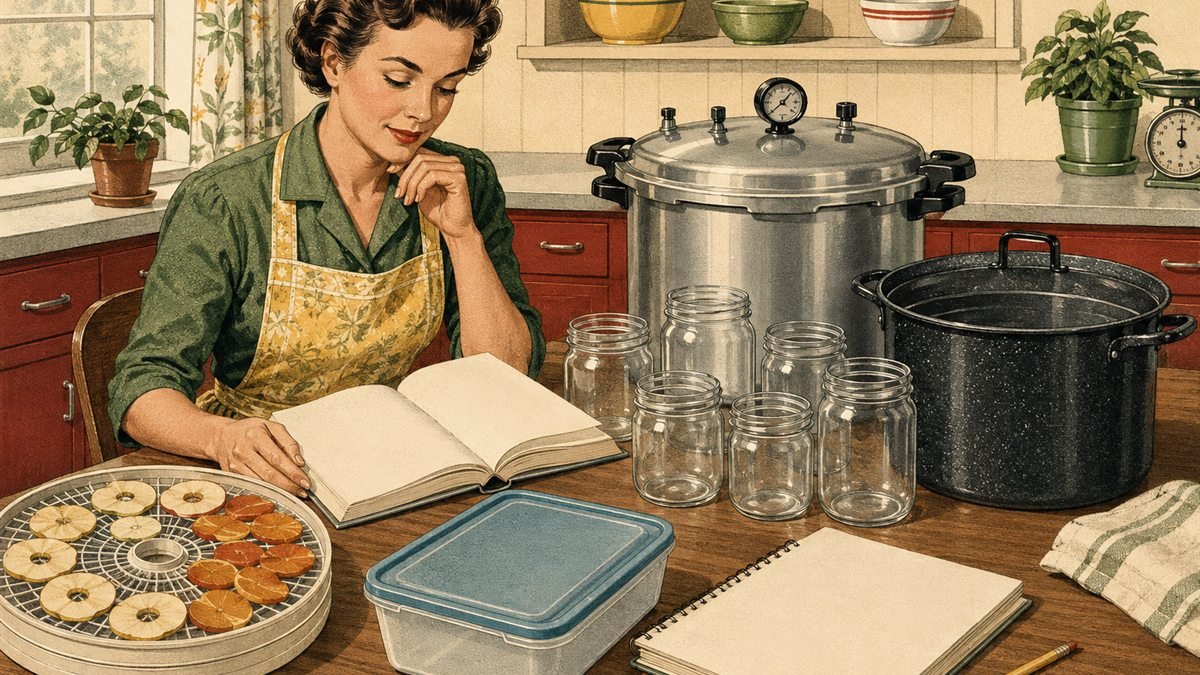
Choose a preservation method by the food and its final storage conditions, then follow a current research-tested process exactly. A method-selection table can point you in the right direction, but it cannot replace the recipe’s preparation, jar size, time, pressure or temperature, cooling steps, and elevation adjustment.
Use the current USDA Complete Guide to Home Canning or a current recipe from the National Center for Home Food Preservation (NCHFP) or your cooperative extension.
Match the Food to the Method
| Food and goal | Usually appropriate method | Equipment and storage dependency | Stop and verify |
|---|---|---|---|
| Fruit, jam, pickles, or a properly acidified tomato recipe for shelf storage | Boiling-water canning, when the tested recipe specifies it | A suitable boiling-water canner, approved jars and lids, and the exact tested process | Confirm acid ingredients, pack style, jar size, processing time, and elevation adjustment from the recipe |
| Vegetables, meat, poultry, seafood, or most mixed low-acid foods for shelf storage | Pressure canning | A pressure canner large enough for the tested process, a working gauge or weight, approved jars and lids, and the correct elevation pressure | Do not substitute a pressure saucepan or electric multi-cooker for a process developed for a stovetop pressure canner |
| Food that keeps good quality frozen and can remain continuously frozen | Freezing | Freezer-safe packaging, a freezer thermometer, dependable power, and an outage plan | Follow food-specific preparation and blanching directions; freezing does not make unsafe food safe |
| Fruit, vegetables, herbs, or properly prepared jerky for compact storage | Dehydrating | A controlled dehydrator, tested preparation and temperature guidance, moisture-resistant packaging, and cool dry storage | Meat needs its prescribed safety step; dryness by feel alone is not a validated process |
| Already shelf-stable dry food that needs protection from air and moisture | Airtight or vacuum packaging | Food-compatible packaging and a cool, dry, dark storage area | Vacuum sealing is packaging, not a preservation process for moist or perishable food |
If a food does not fit a tested method, freeze it, refrigerate it for prompt use, or choose another recipe. Do not improvise a shelf-stable version.
Before You Start a Batch
- Open the exact current recipe and read it through before preparing the food.
- Record your elevation and use the recipe’s matching time or pressure adjustment.
- Confirm the food, ingredients, proportions, pack style, jar size, and yield.
- Inspect the canner, vent, gauge or weight, gasket, jars, lids, racks, and heat source.
- Make sure you can finish the complete process without interrupting time, heat, or safe cooling.
- Prepare labels for the food, recipe source and edition, process, elevation, and date.
Water-Bath and Pressure Canning
Boiling-water canning is for acid foods and properly acidified recipes specifically tested for it. Low-acid vegetables, meats, poultry, seafood, and mixtures require a pressure canner and a tested process. NCHFP does not support applying USDA pressure-canning processes in electric multi-cookers, and pressure saucepans are not recommended canners.
The NCHFP explains why low-acid foods require pressure canning: boiling-water temperatures cannot reliably control botulism spores in low-acid canned food. Its processing guidance requires the recipe’s elevation-specific time or pressure and natural cooling procedure.
Presto Pressure Canner
Product example only. Verify current specifications, compatibility, safety instructions, price, and availability before buying.
⚠ Affiliate link — we earn a small commission at no extra cost to you.
Use only a recommended canner type. Have dial gauges tested as recommended by the manufacturer or extension service. Vent, pressurize, cool, and open the canner only according to the tested process and manual to prevent underprocessing and steam burns.
Unsafe Shortcuts to Reject
- Do not oven-can, dishwasher-can, open-kettle can, or heat dry foods in sealed jars as a supposed canning process.
- Do not use an untested internet recipe, family recipe, or altered ingredient ratio for shelf-stable canning.
- Do not swap jar sizes, add thickeners, change pack style, or shorten processing unless the tested recipe explicitly permits it.
- Do not assume extra time makes the wrong method safe; low-acid foods still require their tested pressure-canning process.
- Do not force-cool a pressure canner, skip venting, change the specified pressure, or start timing before the required pressure is reached.
- Do not treat a sealed lid, normal smell, or normal appearance as proof that an improvised process was safe.
Dehydrating
Dehydration reduces water activity but does not sterilize food. Use a controlled dehydrator, a tested preparation, and the recommended pretreatment and temperature. Some meats require a kill step; follow current NCHFP jerky instructions rather than drying raw meat by feel.
Cool dried food before packaging, condition fruit when the tested method calls for it, and watch for moisture condensation or mold. NCHFP advises packing dried foods immediately in clean, dry, moisture-resistant containers and storing them in a cool, dry, dark place. Discard moldy food rather than trying to salvage it.
Excalibur Food Dehydrator
Product example only. Verify current specifications, compatibility, safety instructions, price, and availability before buying.
⚠ Affiliate link — we earn a small commission at no extra cost to you.
Freezing
Freezing is often the simplest safe method when dependable power is available. Follow the food-specific directions; NCHFP says almost all vegetables need correctly timed blanching before freezing. Package to reduce air exposure, label dates, and keep a freezer thermometer. Prepare an outage plan before relying on a large frozen inventory, including the USDA’s emergency food-safety limits.
Vacuum Sealing Is Packaging, Not Preservation
Vacuum sealing removes air but does not kill pathogens or make moist food shelf-stable. USDA warns that the low-oxygen package can favor botulism growth in some foods. Refrigerate or freeze perishable vacuum-sealed foods and follow a tested preservation process.
Compare the limits and power needs of freeze-dried, dehydrated, and canned food. For very dry staples, use the separate Mylar and bucket storage process; for an overall rotation plan, build a long-term food pantry.
Keep Records
Label the food, recipe source and edition, pack style, jar size, process, elevation adjustment, and date. Store jars without relying on the screw band to conceal a failed seal, and inspect every jar before opening. Plan how you will use preserved food with safe cooking methods during a power outage.
Your next action is small: choose one food, locate its current tested instructions, confirm the equipment and elevation adjustment, and run one labeled batch before scaling up.