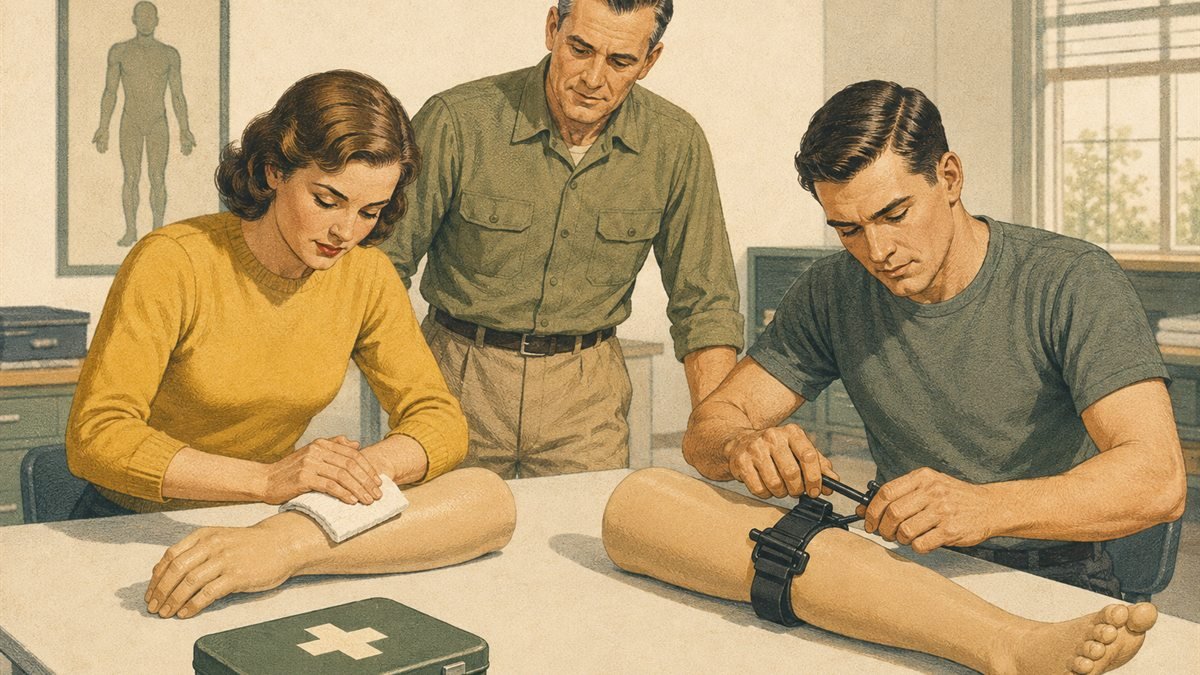
In a trauma emergency — vehicle accident, serious fall, penetrating wound — three things kill people fastest:
- Uncontrolled bleeding (hemorrhage)
- Airway obstruction
- Shock
Everything else — fractures, burns, concussions — is serious, but these three are the ones measured in minutes. Understanding them, and having basic supplies and skills to address them, is the core of trauma preparedness.
Understanding the Timeline
Life-threatening bleeding, an obstructed airway, cardiac arrest, and shock can deteriorate before professional help arrives. Do not wait for a precise volume of blood or a countdown: call emergency services, follow dispatcher instructions, and give care within your training. The Red Cross describes continuously flowing or spurting blood and signs of shock as triggers for immediate emergency treatment.
The MARCH Protocol
MARCH is the trauma response framework used by military and wilderness medicine. It provides a priority order for addressing life threats:
M — Massive hemorrhage (control life-threatening bleeding first) A — Airway (ensure the airway is open and maintained) R — Respiration (address chest injuries affecting breathing) C — Circulation (address shock, secondary circulation problems) H — Hypothermia/Head injury (prevent heat loss; monitor consciousness)
This guide covers M, A, and C — the three most immediately life-threatening.
M: Massive Hemorrhage — Controlling Severe Bleeding
Civilian bleeding-control guidance uses direct pressure, tourniquets for life-threatening limb bleeding, and wound packing for appropriate wounds. Which action comes first depends on the location and severity of the bleeding and the responder’s training.
1. Tourniquet (Limb Injuries)
For life-threatening bleeding from an arm or leg, a commercially manufactured tourniquet can be lifesaving. Call emergency services and follow your training and the device instructions.
When to use a tourniquet:
- Bleeding from a limb that cannot be controlled by direct pressure
- Amputation
- Any limb wound with spurting or rapidly soaking blood loss
How tourniquets are taught to work (per Stop the Bleed and TCCC training):
- Apply 2–3 inches above the wound (not on a joint)
- Tighten until bleeding stops; effective application is painful
- Note the time of application
- Do not remove once applied — removal requires medical assessment
The CAT (Combat Application Tourniquet) and SOFTT-W are the most studied and widely validated civilian tourniquets. Purchase genuine, certified products — counterfeits exist.
CAT Tourniquet Gen 7 (Combat Application Tourniquet)
Product example only. Verify current specifications, compatibility, safety instructions, price, and availability before buying.
⚠ Affiliate link — we earn a small commission at no extra cost to you.
2. Wound Packing with Hemostatic Gauze
Some life-threatening external wounds cannot take a tourniquet. The Red Cross recommends wound packing only when trained, including for appropriate wounds of the scalp, neck, shoulder, groin, or back, or a limb when a tourniquet is unavailable. Do not pack an open chest or abdominal wound.
- Pack hemostatic gauze directly into the wound, as deep as possible
- Apply continuous firm pressure — this requires real physical effort
- Maintain pressure for a sustained period (3–5 minutes minimum per training)
- Apply an Israeli bandage or pressure dressing over the packing to maintain pressure
QuikClot (kaolin-impregnated) gauze and Combat Gauze are the standard hemostatic products validated for wound packing.

QuikClot Advanced Clotting Gauze (4-inch rolls, 3-pack)
Product example only. Verify current specifications, compatibility, safety instructions, price, and availability before buying.
⚠ Affiliate link — we earn a small commission at no extra cost to you.
3. Direct Pressure (Minor-to-Moderate Bleeding)
For external bleeding:
- Apply firm, continuous pressure with a clean dressing
- Do not remove and check — maintain continuous pressure for a minimum of 5–10 minutes
- Add dressings on top if soaking through; do not remove the original dressing
Israeli Bandage Emergency Pressure Dressing (4-inch, 10-pack)
Product example only. Verify current specifications, compatibility, safety instructions, price, and availability before buying.
⚠ Affiliate link — we earn a small commission at no extra cost to you.
A: Airway — Keeping the Passage Open
An unconscious person loses muscle tone, and the tongue can fall backward and obstruct the airway. Airway obstruction is silent and fast — it can happen without the dramatic choking presentation most people expect.
Positioning for an Unconscious, Breathing Person
If a person is unconscious but breathing, and has no suspected spinal injury:
- Recovery position: Roll them onto their side, support with the bent upper knee, tilt the head back slightly to keep the airway open.
- This prevents the tongue from blocking the airway and prevents choking on vomit.
Head-Tilt Chin-Lift
For an unresponsive person with no suspected neck injury:
- Place one hand on the forehead, two fingers under the chin
- Tilt the head back, lift the chin forward — this extends the airway and lifts the tongue off the back of the throat
Rescue Breathing
If a person is unresponsive and not breathing normally, call emergency services and follow dispatcher instructions. The American Heart Association recommends Hands-Only CPR for a bystander who sees a teen or adult suddenly collapse. Infants, children, drowning, overdose, and breathing-related collapse may require conventional CPR with breaths, which is why current training matters.
If you have not taken a CPR course recently, the American Red Cross and American Heart Association both offer widely available courses and online refreshers.
CPR Face Shield Keychain (6-pack)
Product example only. Verify current specifications, compatibility, safety instructions, price, and availability before buying.
⚠ Affiliate link — we earn a small commission at no extra cost to you.
Nasopharyngeal Airway (NPA)
An NPA is an airway adjunct used by trained responders in selected patients. It is not a beginner intervention: use requires patient assessment, correct sizing, knowledge of contraindications, and hands-on training. A device in a kit is not authorization or competence to insert it.
C: Circulation — Recognizing and Managing Shock
Shock is a state of inadequate tissue perfusion — the body is not getting enough oxygen to its tissues. In trauma, hemorrhagic shock (from blood loss) is the primary concern.
Signs of Shock
- Rapid, weak pulse
- Pale, cool, clammy skin
- Rapid breathing
- Altered mental status (confusion, anxiety, unresponsiveness)
- Dizziness or fainting
These signs can appear even when external bleeding is controlled — internal bleeding causes shock without visible blood loss.
What You Can Do
Position: Lay the patient flat. If blood pressure is low, some training references describe elevating the legs — though current TCCC guidance focuses on treating the underlying cause and keeping the patient warm rather than positioning as a primary intervention.
Keep warm: Hypothermia worsens shock significantly. A hypothermic, shocked patient deteriorates faster. Cover with a blanket, emergency bivy, or whatever insulation is available.
Prevent further blood loss: Ensure all identified bleeding is controlled before addressing other injuries.
Reassess: Shocked patients can deteriorate quickly. Monitor breathing, pulse, and responsiveness continuously.
Transport: Shock requires definitive medical care. All interventions are supportive bridges to hospital treatment. If there is any possibility of getting professional medical care, pursue it.
Emergency Mylar Thermal Blanket (10-pack)
Product example only. Verify current specifications, compatibility, safety instructions, price, and availability before buying.
⚠ Affiliate link — we earn a small commission at no extra cost to you.
When to Prioritize Evacuation
All of these interventions are temporary stabilization measures. The goal is always to get the patient to definitive medical care as quickly as possible.
Evacuate immediately for:
- Chest wounds (potential pneumothorax)
- Penetrating abdominal injury
- Head trauma with altered consciousness
- Suspected internal bleeding
- Shock that doesn’t respond to stabilization measures
- Any injury beyond your training and equipment to manage
Knowing when something is outside your capability is as important as knowing how to act.
Building the Trauma Skill Set
The knowledge in this article is a starting point. The skills require hands-on practice:
| Course | Provider | Focus |
|---|---|---|
| Stop the Bleed | stopthebleed.org | Hemorrhage control (free/low cost) |
| First Aid / CPR | Red Cross, AHA | General first aid and CPR |
| CERT | FEMA / local fire | Community emergency response |
| Wilderness First Responder (WFR) | NOLS, SOLO, others | Extended care, no-evac scenarios |
The Wilderness First Responder certification is particularly relevant for preparedness — it specifically addresses managing medical emergencies when definitive care may be delayed or unavailable. It’s a multi-day intensive course widely offered by outdoor education organizations.