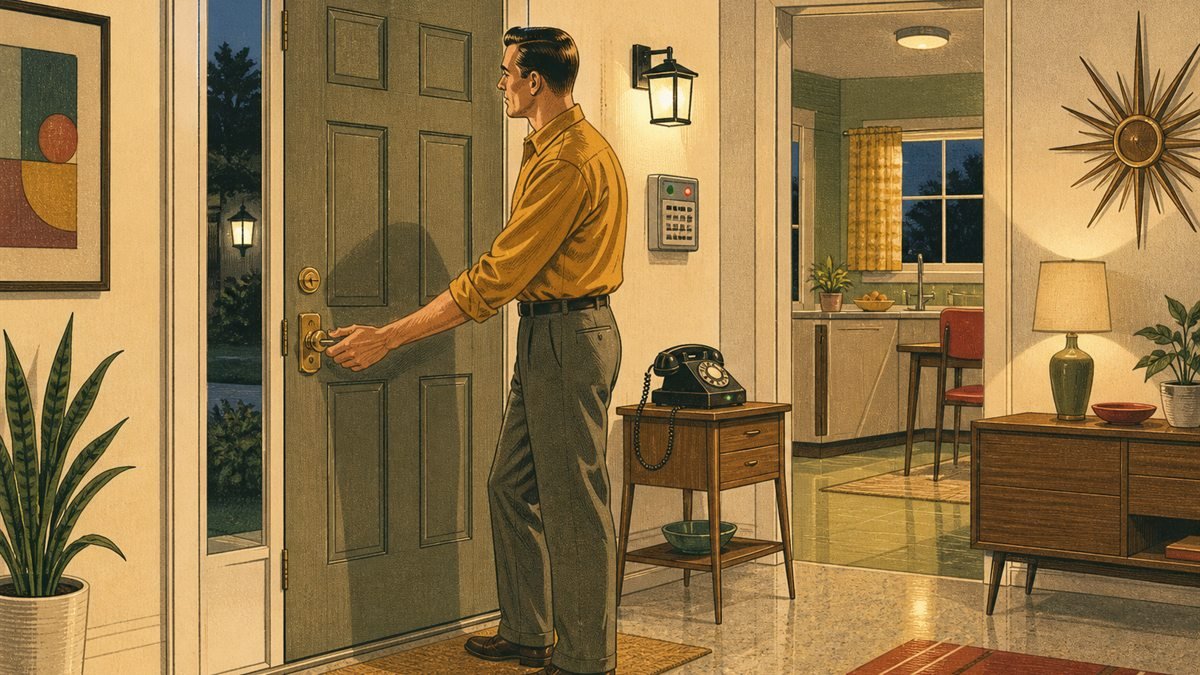
The best less-lethal security plan creates distance and time: deter attention, detect a problem early, delay entry without blocking escape, call for help, and leave or shelter safely. A spray or conducted-energy device is a last layer with legal, medical, storage, and failure risks—not a substitute for locks, lighting, alarms, communication, or an exit.
“Non-lethal” is a marketing category, not a guarantee. Pepper spray and conducted-energy devices can injure, expose bystanders, contribute to a fall or medical emergency, or fail under stress. Treat them as less-lethal force options and make avoidance and disengagement the default.
Build the Layers in Order
| Layer | Practical options | Failure to plan for |
|---|---|---|
| Deter | Maintained property, visible address, useful exterior lighting, occupancy cues, neighbor contact | Glare and deep shadows, predictable timers, advertising that the home is empty |
| Detect | Door/window sensors, local alarms, cameras, a dog that alerts, neighbor check-ins | Dead batteries, failed internet, blind spots, false alarms, no one assigned to respond |
| Delay | Sound doors and locks, reinforced strike areas, secured accessible windows | A device that traps occupants, violates a lease/code, or cannot be released by a child or person with limited strength |
| Communicate | Charged phone, local siren, emergency numbers, family code words, clear address information | No signal or power, an inaudible alarm, household members who do not know the plan |
| Escape or shelter | Two usable exits where possible, outside meeting point, a room that can be secured while help is called | Blocked windows, missing keys, mobility barriers, no plan for children, visitors, or pets |
Start with a room-by-room home-security hardening assessment and an outage-aware perimeter and lighting check. The U.S. Fire Administration advises identifying two ways out of each room where possible and keeping doors and windows unobstructed; security hardware must preserve that home fire-escape plan.
Complete the Jurisdiction and Household Check
Before buying, carrying, installing, or practicing with any security device, answer these questions:
- Current law: What do the current state statutes and local rules say about possession, carry, age, product type or capacity, restricted locations, transport, use, and post-incident duties? Start with official state and local government directories, then read the actual statute or ask a qualified local authority or attorney.
- Cameras and audio: Where may the camera point, is audio captured, who can be recorded, what notice or consent is required, how long is footage retained, and who can access it? A Congressional Research Service overview documents that state interception and consent statutes differ; it is a research starting point, not a substitute for the current law in your jurisdiction.
- Housing rules: Does a landlord, condominium association, or insurer restrict exterior fixtures, locks, door bars, wiring, or fuel/battery storage?
- Emergency egress: Can every household member release the device quickly from inside without finding a key or moving heavy furniture? Are two routes still usable?
- People and animals: Can children, visitors, cognitively impaired adults, or pets reach or accidentally activate the device? Where will it be secured while remaining available to the responsible adult?
- Stress and failure: Can the user identify the correct device, disengage its safety, avoid self-exposure, and escape if it fails or is taken away? Use only lawful training products in an appropriate location.
- After an incident: Who calls emergency services, gives first aid, preserves video, secures an exposed device, and meets responders without being mistaken for the threat?
Recheck laws before travel and after moving. Product listings and manufacturer summaries are not legal authority.
Lighting, Alarms, and Cameras
Place exterior lighting to show approaches and faces without shining into neighboring homes or producing glare that hides movement. Confirm the detection pattern, weather rating, manual controls, power source, and performance after several cloudy days or a long outage.
LITOM Solar Motion Security Lights
Product example only. Verify current specifications, compatibility, safety instructions, price, and availability before buying.
⚠ Affiliate link — we earn a small commission at no extra cost to you.
Choose an alarm that can provide a useful local warning if internet or monitoring fails. Test battery runtime, cellular or radio dependence, sensor coverage, siren audibility, and who actually responds. Teach household members how to cancel a false alarm and what to do when the warning is real.

SABRE Wireless DIY Home Security System
Product example only. Verify current specifications, compatibility, safety instructions, price, and availability before buying.
⚠ Affiliate link — we earn a small commission at no extra cost to you.
Cameras can document an event but cannot physically stop it. Confirm the field of view without intruding into private neighboring spaces, decide whether audio should be disabled, and check whether recording continues without internet or utility power. The FTC recommends unique passwords, software updates, encryption, and two-factor authentication where available. Limit remote access and review who can see live and stored footage.
For a wider privacy review—including what household information is visible online—use the preparedness privacy and OPSEC guide.
Dogs Are Dependents, Not Equipment
A dog may alert to unusual activity and its presence may deter some people, but behavior varies by individual and training. Do not acquire or train a dog to attack as a casual preparedness project. Poorly controlled guarding behavior can injure family members, responders, neighbors, or the dog.
Plan food, water, medication, veterinary care, identification, evacuation transport, waste, and safe confinement. Use a qualified reward-based trainer for nuisance barking, fear, or aggression.
Pepper Spray: Add Distance, Not Confidence
Pepper-spray rules vary by jurisdiction and can cover formulation, container size, age, carry locations, shipping, and possession. Verify current law for the places where you live, work, travel, and enter; do not rely on “legal everywhere” product copy.
The National Institute of Justice review describes both effectiveness and health risks. Wind, enclosed spaces, range, obstacles, access under stress, multiple people, canister damage, and expiration can affect exposure and outcome. No spray guarantees that a person will stop.
If it is lawful and appropriate for your circumstances:
- Read the product label, warnings, expiration date, storage range, and disposal instructions.
- Obtain a matching inert trainer where lawful and practice accessing it while moving toward an exit.
- Store it so children and unauthorized users cannot access it; do not leave it where heat or cold exceeds the label limits.
- Avoid practice discharge indoors and avoid contaminating people, pets, food, medical supplies, or evacuation equipment.
- If it is used during an immediate threat, disengage when safe, call emergency services, identify yourself and the exposure, and follow dispatcher instructions.
The CDC’s current riot-control-agent exposure guidance includes pepper spray. After exposure, move away to fresh air, remove contaminated clothing without spreading the agent, wash skin with plenty of soap and water, and rinse burning or blurred eyes with plain water for 10 to 15 minutes. Call emergency services or Poison Control for breathing trouble, severe or persistent symptoms, a large exposure, or situation-specific instructions.

SABRE Pepper Spray
Product example only. Verify current specifications, compatibility, safety instructions, price, and availability before buying.
⚠ Affiliate link — we earn a small commission at no extra cost to you.
Conducted-Energy Devices and Contact Stun Guns
Civilian possession, carry, and use rules vary. These devices require model-specific training, charged batteries, correct range or contact, and an immediate plan to disengage and call for help. They can miss, fail through clothing, ignite flammable vapors, or cause a fall and secondary injury.
The National Institute of Justice’s research summary explains that risk depends on how and how long a device is used and that serious outcomes, while uncommon in the reviewed law-enforcement data, are possible. Civilian products, training, circumstances, and oversight are not identical to police use, so do not turn that evidence into a personal guarantee.
Contact stun guns require physical proximity and may cause pain without incapacitation. Neither device should be presented as a dependable substitute for distance, escape, or emergency communication. Secure any device from children and unauthorized users, inspect it on the manufacturer schedule, and never conduct a live exposure drill.
Personal Alarms and Entry Delay
A pull-pin alarm may attract attention and help others locate you, but it needs a response plan. Verify its activation method, attachment, battery replacement, and safe test procedure. Warn others before testing and protect hearing.
SABRE Personal Alarm with LED
Product example only. Verify current specifications, compatibility, safety instructions, price, and availability before buying.
⚠ Affiliate link — we earn a small commission at no extra cost to you.
Door bars, braces, and window devices may add delay, but they must not trap occupants or block an emergency exit. Check fire code, lease terms, accessibility, household strength, responder access, and quick release from inside. Practice both primary and backup exits with the hardware in its normal nighttime position.
Next Actions
- Walk the property in daylight and after dark; fix visibility, address marking, locks, and alarm coverage first.
- Draw two escape routes where possible and test them with every household member.
- Complete the jurisdiction and household checklist for each proposed camera, barrier, spray, or electrical device.
- Write a simple call-and-disengage plan and support it with off-grid emergency communications.
- If comparing any force option, review the same storage, legal, training, and failure questions in the firearm safety decision context. The comparison does not make either option appropriate for every household.
Sources and Further Reading
- U.S. Fire Administration: Home Fire Escape Plans
- FTC: How to Secure Home Security Cameras
- CDC: Riot Control Agents and Exposure Response
- National Institute of Justice: Pepper Spray Effects and Effectiveness
- National Institute of Justice: Conducted-Energy Device Policies and Risks
- Congressional Research Service: Electronic Communications Privacy Act Overview
- USA.gov: State and Local Government Directories