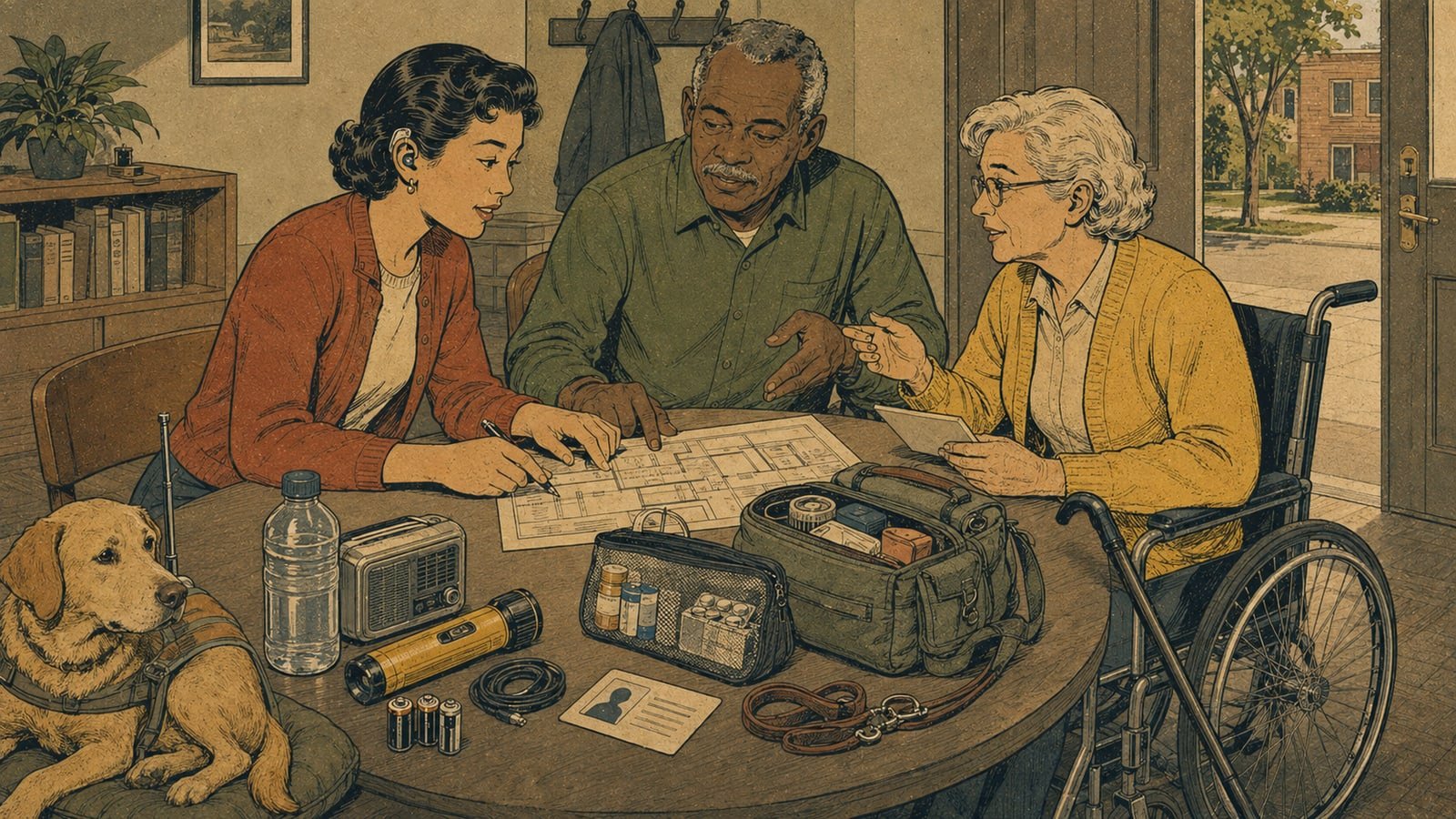
A good emergency plan starts with the person, not a diagnosis. Ask three questions: what must keep working, what help does the person want, and who or what is the backup if the usual help isn’t there? This guide is for people with disabilities, older adults, and the family members and caregivers who help them. Make the plan with the person whenever you can.
This guide follows the CDC, Ready.gov, and the FDA.
The Short Version
Buy this:
- Spare batteries and portable chargers for hearing aids and other equipment
- A waterproof pouch for your contact list, medicine list, and copies of insurance cards
- A cooler for refrigerated medicines, if their labels allow
- Backup glasses, hearing aid batteries, and a spare cane or walker if you can get one
- Food, water, and supplies for any service animal or pet
Do this today:
- Name at least two people who can check on you in an emergency, and one who lives farther away.
- Write a medicine list and a short care summary.
- List every device that needs power, and how long its battery lasts.
- Ask your power company about its list for customers who rely on medical equipment.
- Find out who provides accessible emergency transportation in your area.
What to Buy
Portable Power Bank
Keeps a phone, hearing aid charger, or other small device going in an outage. Check that it has the right plug for each device, and keep it charged.
⚠ Affiliate link — we earn a small commission at no extra cost to you.
Waterproof Document Pouch
Holds your contact list, medicine list, and copies of insurance cards. Pick one that seals fully, and check the papers inside twice a year.
⚠ Affiliate link — we earn a small commission at no extra cost to you.
Medical Alert ID Bracelet
Tells responders about key conditions or needs if you can't. Keep the engraved details short and up to date.
⚠ Affiliate link — we earn a small commission at no extra cost to you.
Step 1: Build a Support Network
Ready.gov says to create a support network of people who can help you in a disaster. That can be family, friends, neighbors, caregivers, or care agencies.
For each person, agree on:
- What they’ll do: check in, bring medicine, drive, interpret, or care for an animal
- When they’ll act: an alert, a power outage, or a missed check-in
- How they’ll reach you: call, text, video, or in person
- How they’ll get in: a key, a door code, or a meeting spot
“Call my daughter” is one plan, not a backup. Add a second person, ideally outside your area, in case the first is also affected. Share only the details each person needs.
A good habit for helpers: ask “How do you want me to help?” and then follow the person’s lead.
Step 2: Write a Care Summary and Medicine List
The FDA says a medicine list should include each medicine’s name, strength, what it’s for, and when, how, and how much you take, plus allergies and emergency contacts.
Add a short care summary:
- How the person communicates and what help they want
- Main conditions, doctors, pharmacy, and equipment suppliers
- Device names, models, and settings
- What’s normal for the person, so responders don’t misread it
Ready.gov also suggests copies of Medicaid, Medicare, and other insurance cards. Keep everything in a waterproof pouch. See the emergency documents guide.
Step 3: Pack the Kit
The CDC suggests adding these to your emergency kit:
- At least 1 week’s supply of all prescription medicines, and a cooler for refrigerated ones
- Batteries and portable chargers for equipment such as hearing aids
- Any communication aids you need
- Medical supplies and important health documents
- Extra mobility devices, such as a cane or walker, if you can get them
- A contact list in a watertight container
- Food, water, medicine, and waste bags for service animals and pets
Ask your pharmacist and prescriber how to get the extra medicine safely and legally. The CDC says to check kits every 6 months. See the emergency medication plan.
Step 4: Plan for Power
- Ready.gov says to talk to your doctor or health care provider about how to keep a powered device running during an outage.
- Ready.gov also says you can ask your power company to put you on a list for priority power restoration. A list doesn’t guarantee faster power, so keep a backup plan.
- Ask the device maker which backup batteries or power sources are safe for it. The battery power station guide can help.
- Decide where you’d go if your backup runs low, and leave early enough to get there.
Step 5: Plan Transport and Shelter
- Arrange transport early. The CDC says accessible transportation may not be available in an emergency, even if you planned for it. Contact your paratransit provider or local government ahead of time to find out who provides emergency transportation.
- Have two destinations, such as a friend’s home and a shelter, that can meet your needs.
- High-rise buildings: ask your building manager and local fire department how they help people who can’t use stairs. See the apartment emergency guide.
- At a shelter: the CDC says to tell shelter workers what you need when you arrive and keep your health information with you. Wear a medical alert tag if you have one.
- Animals: the CDC says shelters must allow service animals by law. Ready.gov notes that not all shelters accept pets, so plan for other options.
Step 6: Plan Communication and Practice
- Sign up for local alerts in the formats you can use: text, sound, or vibration.
- Ready.gov suggests laminated cards with key phrases or pictures in case your equipment stops working.
- Talk to the person directly, not only to their caregiver or interpreter.
- Practice once: gather the kit, go to the pickup spot, and call your backup helper. Let the person set the pace and stop any time. Fix what didn’t work.
See off-grid communications for backup ways to stay in touch.
Common Mistakes
- Making the plan without the person. It’s their plan. Ask what they want.
- Only one helper. That person may be stuck or evacuating too.
- Forgetting chargers and cables. A device without power doesn’t help.
- Assuming responders will carry someone down the stairs. Ask your building and fire department first.
- Never updating it. Review the plan after any move, health change, or new caregiver.
Frequently Asked Questions
What should a person with a disability have in an emergency kit?
The CDC suggests at least a week of prescription medicines, chargers and batteries for equipment, communication aids, medical supplies and documents, a contact list in a watertight container, and supplies for any service animal.
Can my service animal come with me to a shelter?
The CDC says shelters must allow service animals by law. Pack food, water, medicine, and waste bags for the animal.
How can caregivers help an older adult prepare?
Make the plan together. Build a support network, write a medicine list and care summary, pack the kit, and plan transport ahead of time. Ready.gov’s older adults page is a good checklist.
Next steps: plan for chronic conditions in an outage, make a household emergency plan, and build a pet emergency kit if you have animals.